Showing posts with label 5th Generation Stealth Fighter. Show all posts

Wednesday, December 30, 2015

Chinese Stealth Fighter J-20 Mighty dragon Goes Low RateInitial Production

In a Christmas gift for Chinese fighter pilots, December 25th saw the unveiling of a new J-20 fighter in fresh yellow fuselage primer on the runway of the Chengdu Aviation Corporation (CAC) factory. More notable than its paint color, however, was the numbering of the plane: "2101." As opposed to "2018" or "2019" to follow the eighth flying prototype "2017," "2101" suggests the plane is the first of the low rate initial production (LRIP) airframes, which signify the move away from prototype production to building fighters for actual military use.
"2101" rolled out of the factory on December 26, 2015, still in its bright yellow factory primer. 2101 is structurally most similar to "2016" and "2017", the 7th and 8th J-20 prototypes. With the first LRIP squadron likely to be completed by the end of 2016, Chinese pilots will quickly put the J-20 through the paces to push every bit of capability out of their new stealth fighters.
LRIP is the stage in the program where CAC will build enough production fighters (about 12-24) for test and evaluation flights by the PLAAF to understand the J-20's capabilities, before further committing to large-scale production. Initial operational capability should come around in the 2018-2019 timeframe, once the Chinese Test Flight Establishment (CTFE) regiment develops the technical proficiency and competence to use the J-20 to the fullest in combat operations.

"2101" is the ninth J-20 fighter built by the CAC in under five years (the first J-20 prototype flew in January 2011). In comparison, the first production F-35A (AF-6) flew in February 2011, five years after the first F-35 prototype flew in February 2006. The F-22 also took about five years to transition from first flight to LRIP (September 1997 and February 2002).

Given over a decade's worth of global technology advances, intensive investment and competent program management, it should come as no surprise that China will be the second nation in the world to start production of stealth fighters. The J-20 will give the PLAAF a technological advantage over every other Asian air force. While the J-20 may not be able to supercruise (fly at supersonic speeds without using fuel-thirsty afterburners) with its current Russian AL-31 turbofan engines, its high level of stealth, long range and electronic warfare capabilities will make it a very formidable foe for other fighters.

The J-20 also carries a powerful active electronically scanned array (AESA) radar, nose-mounted infrared search and tracking sensors, and fuselage-mounted cameras to give its pilot a VR 360 degree imaging (similar to the F-35's avionics). For weapons, the J-20 would have long-range missiles like the PL-12, PL-15, and PL-21, and short-ranged infrared-guided PL-8 and PL-10. Networked with other platforms such as the Divine Eagle anti-stealth drone, the J-20's array of sensors will give it the ability to go toe-to-toe with other stealth fighters.

While the J-20 certainly a formidable foe today, in the next several years of development advances, its capabilities can be expected to grow. Future J-20's will likely have super-cruise capable Chinese WS-15 turbofan engines and improved gallium nitride AESA radars, with further out options including pilot controlled UAVs. As J-20 testing wraps up, the PLAAF will also have many other new projects to roll out, like the J-31 stealth fighter, H-20 stealth bomber, Sharp Sword stealth UAV and hypersonic weaponry.

Source: Popsci

Thursday, November 26, 2015

Prototype No. 2017: Its May Be The Production Model Prototype of The J-20 Mighty Dragon

Just after three months from the 7th prototype of the J-20 Mighty Dragon its the 8th prototype of this 5th Gen. fighter rolled out. Its not that much wonder that engineers, scientists & technicians in the Chengdu are doing very much well to be ahead of their projected timeline for J-20's production model freezing target date. They did it regarding some previous prototypes, built prototypes faster & stunned technological world.

Till the date, Chengdu builds 8 prototypes of this stealth fighter. It was speculative in some of those previous prototypes that they're doing major-minor changes and correctional design works. And none of them were graced with festive mode, which, J-20 prototype no. 2017 embraced. Some other forward fuselage features redesigned with extreme care and looks like Chengdu gonna freeze the final design for Low Rate Initial Production (LRIP). Its a little bit tough to assume the final design because the brains are working inside there in Chengdu frequently changed design features of the Mighty Dragon. But, due to some simple but thoughtful clues, now it seems that the final LRIP design for J-20 gonna freeze.

Why? Because it was never seen that none of those previous prototypes were being celebrated except first prototype. And, the number "eight", its literally enough for any advanced fighter to be build un their development phases.

Firstly, In the picture it is speculative that women are hailing the prototype no. 2017 with flowers and people are likely in joyous mode, seeing the Dragon. Its might hints that it is the last prototype and this model finalized for production. There in China its the tradition to celebrate something important to start with in festive occasions.

Secondly, to develop any fighter aircraft its conventionally enough to build five-ten prototypes if there not any teething problem causing severe delay in development. Hence no sign of development problem of J-20 has been seen yet, it is likely that development of this fighter were & still smooth enough except powerful engine. The development of airframe and other sub-systems were smooth and tests being conducted simultaneously on an An-204 & Y-8 platform to reduce development time and advance the development process. First two, 2001 & 2002, was mainly demonstrators. Prototype no. 2011, 2012, 2013, 2015, 2016 & 2017 are intended for heavy trials and experiments for all aspects. Regarding stealth performances developers shuffles their designs with extreme catholicism. Rear fuselage, engine exhaust covering, forward fuselage, forward canard, radome and wing design was reshuffled several times to refine the final airframe design.

Due to this speculations and from experts views it can be concluded that world gonna see soon the LRIP small batch of J-20 Mighty Dragon ruling over the Asian skies; though, the intended engine for J-20 is still not ready.

Here this is the forward fuselage comparisons between prototype no. 2011 & prototype no. 2017 (the last one). It shows the differences between two models' radome shape for AESA, DSI bump in the mouth of intakes, raised canopy tinted with gold gloss and some other minor redesigning on the intakes' outer surface etc.

J-31 Gyrfalcon, A Supplement to China’s J-20 Against US F-22 and F-35 Fighters

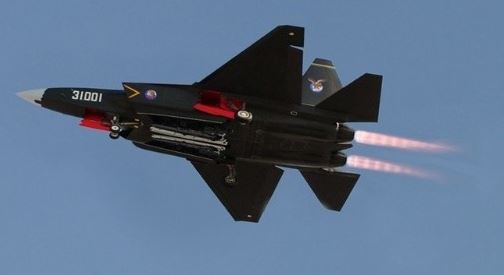
The 16th Beijing International Aviation & Aerospace Exhibition was held from September 16th to 19th, and the large model of China’s J-31 “Gyrfalcon” stealth fighter was displayed, which is a fifth Generation Multi-Purpose Medium Fighter aiming at international market, a stealth fighter of the same generation as US F-22 and F-35 fighters.

According to information revealed on the expo, aerodynamic performance and stealth performance of Chinese J-31 (FC-31) stealth fighter exceed many traditional fighters, and its avionics system will also be upgraded.

Some other specification of J-31 fighter was also unveiled. The highest speed of J-31 stealth fighter is Mach 1.8, and the largest combat radius is 2000 kilometers, which meet demands for carrier-based aircrafts.

Besides, J-31 stealth fighters owns absolutely independent intellectual property, excellent composite combat performance, single-seat double-engine, twin vertical fin and flying tail, large S-type bending air inlets on two sides, and interior weapon cabins.

Chinese J-31 fighter

Like US F-22 and F-35 fighters, China’s J-31 stealth fighter also features high viability, low radar detectability and low infrared radiation, as well as outstanding electronic countermeasures and low vulnerability design. J-31 also has powerful target detecting capability and outer information composite ability, excellent situation awareness, information sharing ability, multi targets BVR attack, arge off-boresight launching all-round air combat ability, air-to-land and air-to-sea precise attack ability.

With multiple mature technologies, J-31 stealth fighter is expected to be launched for international market in five years, and become a mature and cheap fifth generation fighter by 2024, and thus replace JF-17 block 2 as an exporting fighter jet of China.

J-31’s developer AVIC also revealed that J-31 fighter will be very cheap, might be cheaper than the fourth generation fighters of the west, bad news for western countries.

US F-35 fighter

German media reported that J-31 plagiarizes a lot of technologies of F-35 fighter, but Russian expert thinks J-31 is not a copycat of F-35.

J-31 fighter is now using Russian RD-93 engine, which will be replaced by homemade WS-13 upgrade version, and will have variants including carrier-based aircraft and fighter bomber.

In face of F-22 and F-35 stealth fighters of USA, China’s J-31 might enter service in 2020, and another stealth fighter of China J-20 owns long-range attach ability and can reach West Pacific. J-31 will be a supplement to J-20 fighter.

American officials think if China’s training, fighter amount, radar reliability and other airborne devices keep making progress, J-31 stealth fighter will soon exceed American main fighters – F-15 and F/A-18, and thus become a super weapon of China.

Wednesday, May 13, 2015

Analysis: End of year surge for Chengdu J-20 fighter programme

In November and December 2014 two additional prototypes of the Chengdu Aircraft Corporation's (CAC) J-20 fifth-generation fighter emerged, advancing its development towards a possible initial operational capability (IOC) of 2017-18.
A view of the latest J-20 prototype, 2015, which made its maiden flight from the CAC airfield on 18 December. (Chinese internet).
The J-20 programme currently features six known prototypes. Two are early technology development articles (serial numbers 2001 and 2002) that emerged in 2009 and 2010, while four are modified versions closer to operational prototypes (serial numbers 2011, 2012, 2013, and 2015) that all emerged in 2014.

No prototype numbered 2014 has yet to appear and may not, given the traditional Chinese view that four is an unlucky number.
Chinese aircraft spotters responsible for early internet photos report that the latest J-20 prototype, 2015, made its maiden flight from the CAC airfield on 18 December.
hinese aircraft spotters responsible for early internet photos report that the latest prototypes, 2013 and 2015, made their maiden flights from the CAC airfield on 29 November and 18 December 2014 respectively.

Both have most of the refinements seen on aircraft 2011, which emerged in February 2014: cropped canards and vertical stabilisers, a modified air intake, modified wing leading-edge extensions, and a new electro-optical targeting system (EOTS) under the nose.

However, 2013 and 2015 lack the nose-mounted pitot tubes that featured on the earlier prototypes. In addition, number 2015 has longer and sharper-shaped rear-fuselage horizontal strakes. Although this aft surface does not appear to be movable, it may contribute to aircraft stability, as a similar - though movable - surface did for the Grumman X-29 technology demonstrator.

A detail of the strakes on the latest J-20 prototype, 2015. (Chinese internet).
Early internet-sourced images have also emerged of the J-20's retractable refuelling probe, placed on the upper starboard of the nose. The development status of an indigenous Chinese turbofan for the J-20, often referred to as the WS-15, remains unknown. There is speculation that early J-20 examples may use a version of the Russian Saturn AL-31 turbofan.

In April 2014 an Asian government source told IHS Jane's that China would have 24 J-20s by 2020, which if realised, could constitute a first operational regiment. This would indicate that IOC may occur in the 2017-18 timeframe.
Source: Janes

Saturday, April 11, 2015

First Image Of F-35C Carrying Full Load Of Weapons (Externally)


On Jan. 13, RAF Squadron Ldr. Andy Edgell flew first F-35C, the U.S. Navy’s carrier variant of the Joint Strike Fighter,with external GBU-12s, AIM-9Xs air-to-air missiles and the centerline gun pod.

Obviously, a radar-evading plane loses some of its stealthiness with such an external payload…

Image credit: Andy Wolfe via Lockheed Martin

Thursday, July 3, 2014

India Has No Plan To Join Or Buy The US-led Joint Strike Fighter (JSF) Programme

India has no plans as of now to either join the US-led joint strike fighter (JSF) programme or buy the F-35 `Lightning-II' fifth-generation fighter aircraft (FGFA) when it finally becomes operational. "We cannot have two types of FGFA. We have already launched preliminary work for our FGFA after inking the $295 million preliminary design contract (PDC) with Russia last month,'' said a top defence ministry official on Friday. 

This comes in the wake of comments made by a top Pentagon official, undersecretary of defence for acquisition, technology and logistics Ashton Carter, in Washington that the US was open to Indian participation in its JSF project. Interestingly, the comments came during a function where an aggressive sales pitch was made for India to select either the American F/A-18 `Super Hornet' ( Boeing) or F-16 `Falcon' ( Lockheed Martin) over their European rivals in the ongoing IAF's medium multi-role combat aircraft (MMRCA) contest. 

The other 4.5-generation fighters in the hotly-contested race to bag the $10.4 billion MMRCA project, under which 18 jets will be bought off-the-shelf and another 108 will be manufactured in India under transfer of technology, are Eurofighter Typhoon, Swedish Gripen (Saab), French Rafale (Dassault) and Russian MiG-35 (United Aircraft Corporation). The IAF force matrix for the coming years revolves around the 270 Sukhoi-30MKIs contracted from Russia for around $12 billion, the 126 MMRCA and 120 indigenous Tejas Light Combat Aircraft, apart from upgraded MiG-29s and Mirage-2000s. In the decades ahead, the advanced stealth FGFA to be developed with Russia will be the mainstay of India's combat fleet. "Our FGFA will be cheaper than the F-35. Moreover, the intellectual property rights of the FGFA will equally and jointly vest on both India and Russia, with full access to the source code and the like,'' said another senior official. 

With a potent mix of super-manoeuvrability and supersonic cruising ability, the "swing-role'' FGFA will of course not come cheap. The cost of designing, infrastructure build-up, prototype development and flight testing has been pegged at around $11 billion, with India and Russia chipping in with $5.5 billion each. Over and above this, each of the 250-300 FGFA India hopes to begin inducting from 2020 onwards will cost around $100 million each. In all, India will spend upwards of $35 billion over the next two decades in its biggest-ever defence project till now. 

The Indian FGFA will primarily be based on the single-seater Sukhoi T-50, the prototype of which is already flying in Russia, but will include a twin-seater version and a more powerful engine with greater thrust. "Its complete design will be frozen by the end of the 18-month PDC. Six to seven of its prototypes should be flying by 2017. After that, there will be 2,500 hours of flight-testing over 25 months before the series production begins in 2019,'' he said.

Russia Seeks To Sell PAK-FA Stealth Fighter Jets To S. Korea

Russia has decided to enter Korea’s advanced jet acquisition project, which would be the biggest arms-procurement deal ever in the country, a defense official said Wednesday. 

“Russian aircraft manufacturer Sukhoi expressed its intent to compete in the fighter jet procurement project early this year,” Col. Wi Jong-seong of the Defense Acquisition Program Administration (DAPA) said. 

He said Sukhoi’s T-50 PAK-FA will vie with the F-15SE Silent Eagle from Boeing, the F-35 Lightning II f4rom Lockheed Martin and the Eurofighter Typhoon from the European Aeronautic Defense and Space Company (EADS). 

The T-50 PAK-FA and the F-35 Lightning II are fifth generation stealth fighters, while the remaining two are fourth generation jets with limited stealth capabilities. 

Earlier in the day, DAPA spokesman Son Hyeong-yeong announced that his agency has eased the criteria to allow more companies to bid for the FX-III project, under which Korea will purchase 60 high-end fighters with a budget of 8.29 trillion won ($7.86 billion). 

“We will set up strategies that will allow for the transfer of core technology and that will encourage competition,” he said. 

Insiders, however, say both the T-50 PAK-FA and Eurofighter Typhoon have a little chance in winning the bid as Korea’s alliance with the United States will be a decisive factor in the race. 

They say EADS offered a better deal in Korea’s last jet acquisition project in 2008 than its American competitor Boeing, but lost the bid due largely to political decisions. 

Boeing and Lockheed Martin, two of the largest defense contractors in the United States, say they have had a long industrial partnership with Korea and their fighters offer high compatibility with its existing weapons systems. 

EADS recently announced that it will offer Korea the chance to assemble and partly manufacture Eurofighter Typhoons in Korea in an apparent bid not to lose the FX-race again. 

“The first 10 deliveries will be assembled in Europe, while the next 24 will be built with components manufactured in Korea,” Erwin Obermeier, a senior advisor of export projects at EADS said, adding that the remainder will be assembled here. 

He also downplayed concerns over compatibility, saying all Korean fighters and Eurofighters are built to be inter-operable in the NATO environment. 

Korea has purchased 60 F-15s from Boeing, which won both the FX-I and II projects in 2002 and 2008 

Meanwhile, DAPA announced that Korea will spend 1.84 trillion won to acquire 36 attack helicopters from overseas. Col. Tan Myeong-hoon of DAPA said the AH-1W SuperCobra by Bell and AH-64D Block III from Boeing, will compete with the EC-665 Tiger from Eurocopter of France and the T-129 from Turkey. 

The winners of the FX-III and the attack helicopter bids will be announced in October next year.

Saturday, March 15, 2014

Third Chengdu J-20 prototype flies

The third prototype of the Chengdu J-20 stealth fighter made its maiden flight successfully on Saturday 1st March. According to the witness report on Chinese social media, the J-20 prototype “2011″ took the sky at about 12:00 local time, escorted by a Chengdu J-10S two-seater fighter. The entire flight lasted about 30 minutes before the aircraft landed safely.

The “2011″ prototype was first spotted at the test airfield of the Chengdu Aircraft Industry Corporation (CAIC) preparing for its maiden flight in early 2014. A low-speed taxi test took place on 16 January, followed by a high-speed taxi test on 18 January.

J-20 prototype “2011″ in take-off during its maiden flight
The maiden flight of the first J-20 prototype “2001″ in January 2011 took the Western intelligence completely by surprise. A second prototype “2002″ then made its maiden flight in May 2012.

Compared with its two predecessors, the “2011″ prototype features a number of modifications in its aerodynamic design and systems, with the most notable being a chin-mounted electro-optical targeting system (EOTS). Other modifications include new air intakes, redesigned nose section, differently shaped leading-edge extension, redesigned frame-strengthened canopy, different gear bays, and slightly different forward canard and tail fin tips. In addition, the aircraft also wears a new light-grey colour radar-absorbing coating.

(Top) J-20 prototype “2001″ that first flew in January 2011; (Bottom) The new J-20 prototype “2011″
The latest flight test suggests that rather than serving as a technology demonstrator, the J-20 may be on its way to become the world’s third operational 5th-generation fighter, after the Boeing F-22A Raptor and the Lockheed Martin F-35 Lighting II. However, before this can happen Chengdu engineers will need to overcome a number of technical obstacles, such as the lack of indigenous turbofan jet engine and credible avionics.

Tuesday, March 11, 2014

New US fighter jet exceeds budget by billions

Next generation F-35 fighter jet is years behind schedule and costing billions over its allocated budget.


As the White House scales back US military spending, the Navy has just drastically reduced its order of the new F-35 stealth fighter jet.

The deployment of the F-35 is years behind schedule and billions over budget.

Al Jazeera's Rosiland Jordan reports from Washington.

Stealth Changes for China’s Stealth Fighter

When China unveiled its J-20 stealth fighter in 2011, analysts noted the aircraft’s potential to shift the regional balance of power further in the favor of the People’s Liberation Army Air Force. And the country is clearly committed to investing in military hardware. On Wednesday, China announced it was increasing its defense spending in 2014 to 808.23 billion renminbi, or about $132 billion, a rise of 12.2 percent. 
 
Sonic boom of J-20 Mighty Dragon
But many analysts have suggested that the J-20, ostensibly the showpiece of the air force’s modernization, had the “look” of being stealthy without actually incorporating many of the details that make aircraft difficult to detect on radar, as the defense journalist David Axe noted in The Diplomat in 2011.

For one thing, Mr. Axe wrote, “several rear-aspect photos seem to show traditional, fixed, round engine nozzles. The F-22, B-2 stealth bomber and now-retired F-117 stealth fighter-bomber all have carefully shaped, angular nozzles meant to scatter radar waves. In the F-22, these nozzles can move, ‘vectoring’ the engine thrust to boost maneuverability. The T-50 can pull the same vectoring trick with its round nozzles. The apparent absence of stealthy nozzles and thrust-vectoring places a hard limit on the J-20’s ability to evade radar detection from behind.”

The J-20’s nozzles are also mounted in such a way that infrared sensors could easily detect their heat signature. (The engines themselves pose a different type of engineering challenge for China, which may be more difficult to overcome.)

But the three aircraft seen so far are prototypes. Their manufacturer, Chengdu Aerospace Corporation, appears to be learning as it tests, based on photos circulating this week.

The first prototype, serial number 2001, shows significant differences from the latest prototype, serial number 2011, in the position and serration of the landing gear doors, the shapes of the nose and engine intakes (just to the rear of the cockpit) and the shape of the vertical stabilizers, or tail fins.

All those areas have been adjusted, presumably for performance and stealthiness reasons, as The Aviationist points out. The latest version also has a different paint scheme, which could mean absolutely nothing, but could also indicate a different type of radar-absorbent coating. The F-22, B-2 and F-35, the world’s only operational stealth aircraft, all use such coatings. 
 
The Chinese J-20 stealth fighter, in Chengdu, Sichuan Province, in 2011.
The J-20 made headlines when it was unveiled, not just because of the technology it represented, but because it came during Defense Secretary Robert M. Gates’s visit to China. At the time, Mr. Gates questioned “just how stealthy” the Chinese fighter really was, then said the Pentagon was stepping up investments in a range of weapons, jet fighters and technology in response to the J-20 and other aspects of the Chinese military buildup in the Pacific. A Pentagon spokesman later said that the J-20 “has not changed the strategic calculus at all.”

The Pentagon has since suggested that the J-20 will be ready for deployment no earlier than 2018, but it remains unclear how many of the planes China could field. China’s other stealthy aircraft prototype, the J-31, produced by Shenyang Aircraft, has been suggested as a potential export. So far the J-20 has, officially, only been earmarked for use by the Chinese military.

Meanwhile, it remains to be seen how much the J-20’s design changes matter and indeed how effective an aircraft it is. But it is evident that the plane’s flight testing, at least, is far more than just a publicity stunt.