Showing posts with label J-31 Gyrfalcon. Show all posts

Thursday, November 26, 2015

J-31 Gyrfalcon, A Supplement to China’s J-20 Against US F-22 and F-35 Fighters

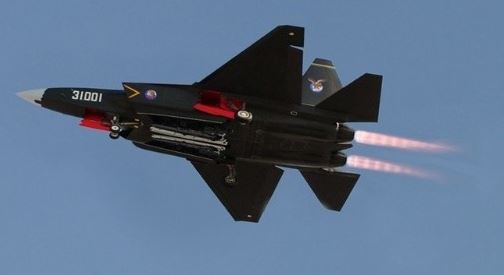
The 16th Beijing International Aviation & Aerospace Exhibition was held from September 16th to 19th, and the large model of China’s J-31 “Gyrfalcon” stealth fighter was displayed, which is a fifth Generation Multi-Purpose Medium Fighter aiming at international market, a stealth fighter of the same generation as US F-22 and F-35 fighters.

According to information revealed on the expo, aerodynamic performance and stealth performance of Chinese J-31 (FC-31) stealth fighter exceed many traditional fighters, and its avionics system will also be upgraded.

Some other specification of J-31 fighter was also unveiled. The highest speed of J-31 stealth fighter is Mach 1.8, and the largest combat radius is 2000 kilometers, which meet demands for carrier-based aircrafts.

Besides, J-31 stealth fighters owns absolutely independent intellectual property, excellent composite combat performance, single-seat double-engine, twin vertical fin and flying tail, large S-type bending air inlets on two sides, and interior weapon cabins.

Chinese J-31 fighter

Like US F-22 and F-35 fighters, China’s J-31 stealth fighter also features high viability, low radar detectability and low infrared radiation, as well as outstanding electronic countermeasures and low vulnerability design. J-31 also has powerful target detecting capability and outer information composite ability, excellent situation awareness, information sharing ability, multi targets BVR attack, arge off-boresight launching all-round air combat ability, air-to-land and air-to-sea precise attack ability.

With multiple mature technologies, J-31 stealth fighter is expected to be launched for international market in five years, and become a mature and cheap fifth generation fighter by 2024, and thus replace JF-17 block 2 as an exporting fighter jet of China.

J-31’s developer AVIC also revealed that J-31 fighter will be very cheap, might be cheaper than the fourth generation fighters of the west, bad news for western countries.

US F-35 fighter

German media reported that J-31 plagiarizes a lot of technologies of F-35 fighter, but Russian expert thinks J-31 is not a copycat of F-35.

J-31 fighter is now using Russian RD-93 engine, which will be replaced by homemade WS-13 upgrade version, and will have variants including carrier-based aircraft and fighter bomber.

In face of F-22 and F-35 stealth fighters of USA, China’s J-31 might enter service in 2020, and another stealth fighter of China J-20 owns long-range attach ability and can reach West Pacific. J-31 will be a supplement to J-20 fighter.

American officials think if China’s training, fighter amount, radar reliability and other airborne devices keep making progress, J-31 stealth fighter will soon exceed American main fighters – F-15 and F/A-18, and thus become a super weapon of China.

Wednesday, October 22, 2014

J-31 Shen Fei (Falcon Eagle) Goes On Chinese Aircraft Carrier "Liaoning"

It  was an aspect that J-31 Shen Fei (Falcon Eagle) stealth fighter jet will go on flight deck of Chinese aircraft carrier "Liaoning".

Full scale model of the Chinese J-31 Shen Fei (Falcon Eagle) Stealth Fighter Jet has been spotted on Flight Deck of Chinese Aircraft Carrier Replica.
 

Stealth Back On Track With Further Flight Tests!

Shenyang J-31 completed another test flight last week and here are photos of that flight.


Friday, March 7, 2014

IN FOCUS: Advanced Chinese fighters: upping the ante_ Greg Waldron

J-10s were displayed during the army's 85th anniversary celebrations
Chinese fighter prototypes leave little doubt about Beijing's airpower ambitions, but further development will prove increasingly challenging.

The weekend of 15-16 September was the perfect time for a new Chinese fighter to emerge. US defense secretary Leon Panetta was about to visit Beijing, and an East China Sea territorial dispute with Japan had antagonised Chinese protestors into destroying Japanese-owned shops and Japanese cars in the streets of several major cities. The emergence of the yet-to-be designated aircraft at the Shenyang Aircraft factory was reminiscent of the Chengdu J-20's first flight, which occurred during a visit by Panetta's predecessor, Robert Gates.

Then again, the timing of the J-21's appearance - which Chinese bloggers have variously designated J-31 and F-60 - may well have had nothing to do with Panetta's visit or tensions with Japan. With China it is impossible to tell. Apparently Chinese president Hu Jintao, with whom Gates was meeting, was unaware of the J-20's first flight until Gates mentioned it.

In the case of the J-21, the fuselage of an aircraft closely resembling the new fighter was spotted in late June aboard the back of a truck, draped in camouflage netting. The only thing certain about the J-21 is that it is yet another indication of China's commitment to modernising the Peoples' Liberation Army Air Force (PLAAF).

As with the Lockheed Martin F-22 and F-35, the J-21 features canted twin tails, a key design feature of low observable aircraft. A single grainy head-on shot shows widely-spaced intakes, similar to the F-35. One clear difference from the F-35 is the presence of two engines. China observers speculate that these are Klimov RD-93s, the powerplant used in the Chengdu/Pakistan Aeronautical Complex JF-17 fighter.

MONEY TALKS


Based on early images, the J-21 would appear to be a more nimble aircraft than the J-20, suggesting that it is optimised for the air superiority mission. Some experts have suggested that the large J-20 is not intended as a fighter, but as a long-range attack aircraft. Despite the clear differences between the two aircraft in size and layout, some western observers speculate that the J-20 and J-21 are competitors, similar to the Lockheed Martin YF-22 and Northrop YF-23 in the early 1990s.

"China's big strength is that there is a lot of money," says Richard Bitzinger, senior fellow of the Military Transformations Programme at Singapore's Rajaratnam School of International Studies. "As long as the defence budget goes up, this will pay dividends in terms of procurement numbers and research and development. In the last 10 years, they have bought upwards of 400-500 fourth generation fighters such as the Chengdu J-10 and Sukhoi Su-30."

He estimates that China possesses the world's largest defence R&D budget after the USA. He says that while it is uncertain that aircraft such as the J-20 and J-21 will be fully developed and eventually deployed, he is certain that they serve a useful role as technology demonstrators to learn about advanced technologies such as stealth, advanced engines and the internal carriage of weapons.
 
 
The WS-10 powers one of the J-20 prototypes
In early March, China said it would raise its defence budget by 11.2% year on year to CNY670 billion ($107 billion), but provided no details of how this would affect aircraft procurement and R&D. Bitzinger believes that about 10% of China's overall budget for 2012 will be spent in these two areas. He notes that in defence white papers, China has indicated that its budget is divided roughly between three main areas: personnel, operations, and procurement (which also includes R&D).

As for the J-20, Chinese media reports suggest that the aircraft's two prototypes have flown over 50 flights. The US Pentagon takes it seriously. In a May 2012 assessment, it said the aircraft could be operational by early 2018. The J-20 is "still in a prototype phase", says David Helvey, the acting deputy assistant secretary of defense for East Asia for the US Department of Defense.

"We'd like to be able to continue to monitor developments to understand exactly what China may intend to use it for, and I wouldn't want to speculate at this point for what those specific missions would be," he adds. "We expect the J-20 to achieve an effective operational capability no sooner than 2018. That reflects our judgment and interpretation of how far they are along in doing the research and development and flight testing of the prototypes."

Japan is also concerned. In August, Tokyo released its annual Defence of Japan white paper. Although it did not mention the J-20 by name, it made a clear allusion to the type, noting "the emergence of high-performance fighter aircraft with excellent stealth capability and situation awareness capabilities".

The obstacles in China's path to developing advanced fighters are formidable. While the airframes of the J-20 and J-21 have clear low observable characteristics, Chinese capabilities in the crucial area of radar absorbent materials are difficult to gauge. The Northrop B-2 bomber, F-22 and F-35 require constant support to ensure their highly confidential coatings remain effective. The nature of these coatings is among the USA's most closely guarded secrets. Indeed, the USA was so intent to preserve its lead in stealth that it steadfastly declined to sell the F-22 even to its closest allies.

China's struggles with aircraft engines are well known. Even the relatively basic JF-17 Thunder uses the Russian Klimov RD-93 for the time being, the same engine believed to power the new J-21. One of the J-20 prototypes is believed to be fitted with a pair of Russian Saturn AL-31 engines, the powerplant for the Su-27 and J-10. The second is believed to use the Chinese-made Shenyang Liming WS-10 powerplant. Most experts believe China's lack of an indigenous high-­performance engine is a major obstacle for its advanced fighter aircraft. An engine even remotely equivalent to the F-22's super-­cruising Pratt & Whitney F119 is years, if not decades, away from reality for China.

To fill these gaps, China has three options, according to report by the Washington DC-based Institute for National Strategic Studies entitled Buy, Build, or Steal: China's Quest for Advanced Military Aviation Technologies. The report asserts that while China's fighter capability is still roughly 15-20 years behind the West's, Beijing is increasingly self-reliant in fighter development and production.

The report concludes that China will find it increasingly difficult to develop ultra high-end aerospace technologies, and its traditional partner Russia is ever more wary of sharing technology owing to fear of intellectual property theft. This will force China to rely increasingly on espionage to obtain advanced capabilities.

TECHNOLOGY FRONTIER


"The Chinese government is pursuing a range of 'indigenous innovation' and technology development programmes, but mastering advanced technologies becomes more difficult and expensive as a country moves closer to the technology frontier," write the report's authors.

"This leads to a second related conclusion: China will likely rely more heavily on espionage to acquire those critical military aviation technologies it cannot acquire legitimately from foreign suppliers or develop on its own."

Aside from the technologies involved in the platforms themselves, integrating them into a comprehensive joint force is essential given the sophisticated foes China could face in any conflict over Taiwan or in the East China Sea.
The J-20 is expected to be operational by 2018
"Weaknesses of the PLAAF include the air force's comparative lack of ability to operate effectively as part of a joint force," says Douglas Barrie, an air warfare analyst with the London-based International Institute for Strategic Studies. "Furthermore, it has no recent combat experience. The introduction of advanced air-to-air and air-to-surface weapons is also comparatively recent."

He adds that the PLAAF is weak in other key areas such as air-to-air refuelling and transport aircraft: "Its long-range bomber aircraft - the Xian H-6 - is obsolescent, though this is partly offset by the integration of long-range cruise missiles. In terms of rectifying shortcomings, the air force does appear to be trying to carry out joint training in conjunction with other arms of the military, and to introduce more demanding training scenarios."

While China appears to be making advances in its fighter fleet - as exemplified by the J-20, J-21 and the hundreds of advanced types it has inducted in the last decade - it still has some distance to go before transforming its improving technical strength into a true combat capability. In addition, the strains of developing a single advanced fighter such as the F-22 or F-35 are vast even for the world's greatest aerospace powers. Attempting to develop both the J-20 and J-21 simultaneously could test even China's determination to join the world's airpower greats. 
 
Source: Flight Global

Thursday, December 26, 2013

China's New Stealth Fighters J-23 and J-25 Revealed

The J-20 and J-31, China's first two stealth fighter Designs, are still in the developmental stages, however secrets regarding the nation's other two fifth generation fighters, the J-23 and J-25, have been revealed on Chinese military websites(Chinese Internet).
The J-23 fighter, designed by the Shenyang Aviation Corporation, is no longer an aircraft based on Russian technology, the report said. Shenyang Aviation Corporation has instead chosen to model the J-23 based on the F-22 Raptor of the United States Air Force as it will provide the People's Liberation Army Air Force or Navy Air Force a better chance to combat American fighters in a potential or a future conflict with America(USA).
According to the leaked news report, the J-23 has a longer fuselage and two v-shape vertical tails which look very similar to the ones used by the F-22 Raptor. If China is able to introduce a 117-S thrust vector control engine from Russia or develop it by itself, the maneuverability of J-23 will also be enhanced gradually, the report said.
China's military has yet to provide details on the development of the J-23, however some political and military analysts, said that the J-23 fighter has already been used in military drills as an enemy aircraft due to its similar appearance to the F-22 Raptor.

Saturday, July 13, 2013

Pic of the day: Close up of China's J-31 stealth fighter


Happy Monday. We're celebrating the nicest day of 2013 so far in Washington by showing you the most high-res photo of China's J-31 stealth fighter we've ever seen.

The J-31 is China's second, smaller stealth fighter after its J-20. The J-31 strongly resembles a cross between Lockheed Martin's F-22 Raptor and its F-35 Joint Strike Fighter. Some speculate that the J-31 is being built as a smaller attack jet meant to compliment the large J-20 -- a plane that may be a high-speed interceptor meant to keep enemy planes far from China's shores. Others think the J-31 could be China's attempt to build a carrier-based stealth fighter given its small size and dual-wheeled nose landing gear. Though, as you can see in this photo, Chinese engineers clearly have yet to add a tail hook to the jet. Despite the close-up nature of this shot, we still can't make out the outlines of the J-31's weapons bays. Though we do notice a pair of what look like rather unstealthy, circular running lights on the bottom of the wingtips

Enjoy, and get out of the office already if you live in DC.