Showing posts with label Boeing Defense. Show all posts
Showing posts with label Boeing Defense. Show all posts
Monday, August 8, 2016

Tuesday, November 17, 2015
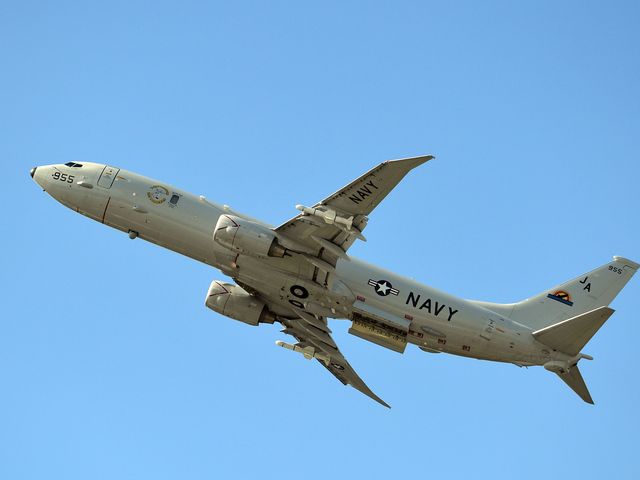
Lockheed Pitches C-130 To UK As Alternative to P-8
As the UK considers how to fill its maritime surveillance gap, Lockheed Martin is pitching a modified version of its C-130 multi-mission aircraft as a cheap alternative to Boeing’s costly P-8 Poseidon.
The UK is currently weighing whether to buy the P-8 after the 2010 Strategic Defence and Security Review scrapped plans to buy BAE Systems’ long-delayed Nimrod MRA4 jet. With the release of the new SDSR just a few weeks away, Lockheed representatives told reporters Nov. 9 the company could modify the UK’s 10 existing C-130s to fulfill the submarine-hunting mission at significantly lower cost.
Lockheed pitched the idea to the UK Ministry of Defence about 18 months ago, according to Peter Ruddock, business development director for the company’s UK contingent. Lockheed has done 90 percent of the work necessary to repurpose the aircraft to fit the maritime surveillance mission, he said. The last piece of the puzzle is integrating the submarine-hunting torpedoes onto the aircraft, a project company engineers are currently working.
Lockheed’s solution will be about 40 percent of the price of the competition, Ruddock said, estimating that the team could get the first four aircraft to full capability in just 41 months.
Lockheed is proposing equipping the UK’s existing C-130 with the mission system developed for the Merlin naval utility helicopter, which is capable of anti-submarine warfare and medium-lift transport, Ruddock said. Lockheed would equip the aircraft with submarine-hunting torpedoes, as well as sonobuoys and life rafts. The aircraft also has advanced EO/IR sensors to detect hostile submarines, he said.
The project also would create jobs in the UK, as 80 percent of the work could be done in-country, Ruddock said.
“We’re not knocking the P-8,” Ruddock said. “I think what we are saying is we can give you P-8-type capability at a much lower cost point because you already have the airframe.”
The UK MOD “rigorously” examined Lockheed’s proposal, and concluded that the project is “credible,” Ruddock said. However, he emphasized the government has not yet set its new requirement or placed any orders for Lockheed’s proposed planes.
On the other hand, Boeing officials say the P-8 is a more cost-effective solution for the UK at the end of the day.
The cost of the P-8 has come down 30 percent, James Detwiler, Boeing’s director of business development for maritime programs, told Defense News on Monday. It is 75 percent cheaper on a cost-per-hour basis to operate the P-8 than the legacy aircraft it is replacing, he said. Additionally, he said, if a foreign nation coordinates its buy with the US Navy’s, both can benefit from the economy of scale.
Many nations are finding that reconfiguring existing aircraft for maritime patrol is actually cost prohibitive, Detwiler said .
Fred Smith, Boeing’s director for global sales and marketing, said the P-8 is cost effective and low risk. However, he acknowledged certain countries that don’t need anti-submarine warfare capability might choose Boeing’s smaller, cheaper Maritime Surveillance Aircraft.
The P-8 is not the right solution for every country, he said during a briefing at the air show.
“We know there is a set of countries that need to do long-range, armed, anti-submarine warfare … they need to protect their strike groups, their carrier battle groups, they need to project power, they need to defend their territories at sea and beyond,” he said. “There are other customers that are looking for other capability, non-anti-submarine warfare, non-armed capability, and we have that on our Maritime Surveillance Aircraft.”
Boeing anticipates selling 100 aircraft internationally over the next ten years, Smith estimated.
Air Force ‘Confident’ Bomber Contract Award Is Airtight
The US Air Force is “confident” that the award of the Long Range Strike-Bomber (LRS-B) contract to Northrop Grumman can withstand the protest recently filed by losing team Boeing and Lockheed Martin, top leadership said here today.
“I am confident that we collectively — and again, 'we' the Air Force, but we had independent peer reviews, as well — that, collectively, we did a very thorough job,” Secretary of the Air Force Deborah Lee James said during a Nov. 10 press conference at the Dubai Air Show. “The evaluation was done according to the [Request for Proposal] evaluation factors.”
The Pentagon announced Northrop as the winner for the competition, which aims to provide 80-100 new bombers for the service to replace the B-52 and B-1 fleets, on Oct. 27. On Nov. 6, Boeing and Lockheed filled their formal protest with the Government Accountability Office.
The GAO now has 100 days to review the protest, examine the Air Force’s source-selection process and issue a ruling. The Air Force expects Boeing’s protest will delay the contract by that 100-day period, but no more, James indicated.
"What is now going to occur is about a 100-day period in which the GAO will be reviewing the contract award, so we expect that, after that 100 days is up, we will proceed accordingly," James said. "So that is the amount of the delay you might see, the period of the GAO review."
If the protest is successful, the GAO could force the Air Force to re-bid the contract, causing further delay to the Air Force’s decades-long effort to build a new bomber. However, James pointed out that the GAO may simply ask the Air Force to “redo” some aspects of the source-selection process.
“The GAO, if they found certain discrepancies, could ask that we redo some of the factors," James said. "It would not necessarily be an entirely new contract situation. So it really depends — it’s too early to say.”
The Air Force, clearly eager to avoid a repeat of the tanker saga of the last decade when a Boeing protest eventually reversed the original award to Airbus, has taken great pains to insulate the LRS-B award. James reiterated during the press conference that the service tasked not one, but two, independent cost estimators to evaluate the program.
“We had a very deliberate process, we took our time, it was key that we do it correctly, we believe that we did do it correctly,” James said. “It’s not just our belief, we had independent reviews at different levels within the Department of Defense to include a legal review, so I would just like to stand by and wait to see what the GAO assesses.”
But despite the Air Force's best efforts, a protest could delay the program and spark an ugly public relations battle, particularly given Boeing's clout on Capitol Hill.
Boeing and Lockheed Martin called the selection process for the LRS-B "fundamentally flawed" in a joint statement last week. Specifically, they take issue with the cost evaluation performed by the government, saying it did not properly reward the team's proposals to break the upward-spiraling historical cost curves of defense acquisitions, and did not properly evaluate the relative or comparative risk of Northrop Grumman's ability to perform, as required by the solicitation.
Northrop Grumman, maker of the stealth B-2 bomber, won the award in part because of a projected cost per plane of $511 million in 2010 dollars, well below the Pentagon's cost cap of $550 million in 2010 dollars. In fiscal 2016 dollars, those figures translate into $563 million and $606 million, respectively.

Monday, March 30, 2015
Boeing has patented a plasma ‘force field’ to protect against shock waves
If it’s ever realised, it could protect military vehicles from energy emitted by nearby blasts.

As weapons get more sophisticated, researchers are trying to build defence systems that can keep pace, and what’s better than a force field?
Aerospace and defence giant Boeing has been awarded a patent to develop a force field-like system that could protect military vehicles from shockwaves following explosions from missiles or improvised explosive devices.
Boeing’s proposed system involves using a combination of lasers, electricity and microwaves to rapidly heat up the air between the vehicle and a blast. This heat creates a plasma shield that's denser than the surrounding air and able to deflect or absorb the energy from the incoming shockwave.
Unlike the impenetrable force fields of science fiction movies, the system is not designed to prevent direct impacts or shrapnel. Instead, Boeing’s system is designed to protect a target - which could be a vehicle carrying troops, or a building such as a command centre or a hospital - from the after-effects of nearby explosions.
The system, which would likely be mounted on a military vehicle, or some other target, would have sensors that can detect the velocity and shape of an incoming threat. The system would also be able to determine the size and force of the resulting explosion.
Its sensors and computers would be able to calculate the time it would take the shock wave from an explosion to reach the target, and from what direction. This is important, as the generated force field would only protect a small region of the target, rather than enveloping the entire thing.
Once it has determined the timing of the shock wave, the system’s objective is to somehow heat the air around the target, generating what Boeing terms a “transient medium” that intercepts the shock wave and reduces the energy density.

As Evan Ackerman from IEEE Spectrum explains:
"The general concept is to use an electromagnetic arc to create this intermediate medium in mid-air on very short notice by using a stupendous amount of energy to heat the air into a plasma.“
The plasma, which is much hotter than the surrounding air, also has a different density and composition. Boeing believes this plasma field is enough to divert, reflect or absorb the energy passing through.
In its application, Boeing outlines several different embodiments of the systems, with different methods for detecting threats, and for rapidly creating the plasma field.
One option uses converging lasers or microwave beams to generate a spherical region of plasma. Alternatively, the force field could be generated by firing lasers that induce plasma channels in the air, which provide a path for an electric discharge to create the plasma shield. These same pathways could be created by launching metal pellets that leave conductive trails as they fly.
However they decide to make it work, it's a pretty cool idea. We'll be waiting for the first the prototype, which may or may not be able to defend against shock waves from this crazy new weapon.
Source: IEEE Spectrum
Sunday, March 30, 2014
Globemaster Up

A C-17 Globemaster III takes off March 14, 2014, from the Geronimo landing zone at Joint Readiness Training Center, Fort Polk, La. Service members participating in JRTC 14-05 are educated in combat patient care and aeromedical evacuation in a simulated combat environment.
Wednesday, February 19, 2014
Boeing unveils updated F/A-XX sixth-gen fighter concept
Boeing is unveiling an updated version of
its F/A-XX sixth-generation fighter concept at the Navy League's
Sea-Air-Space Exposition in Washington DC this week.
The
tail-less twin-engine stealth fighter design comes in "manned and
unmanned options as possibilities per the US Navy," Boeing says. The
design features diverterless supersonic inlets reminiscent of those
found on the Lockheed Martin F-35 Joint Strike Fighter.
 |
|---|
Boeing sixth-gen fighter concept
|
The
Boeing concept also features canards, which is somewhat of a surprise
because the motion of those forward mounted control surfaces is
generally assumed to compromise a stealth aircraft's frontal radar
cross-section. But the lack of vertical tail surfaces suggests the
aircraft would be optimized for all-aspect broadband stealth, which
would be needed for operations in the most challenging anti-access/area
denial environments.
Also of note in the manned version of the
company's F/A-XX concept is the placement of the cockpit-rearward
visibility appears to be restricted without the aid of a sensor
apparatus similar to the F-35's distributed aperture system of six
infrared cameras.
The Boeing F/A-XX concept is a response to a
USN request for information (RFI) from April 2012 soliciting data for a
replacement for the service's Boeing F/A-18E/F Super Hornet and EA-18G
Growler fleets in the 2030s. The Super Hornet fleet is expected to start
reaching the end of the jet's 9000h useful lifespan during that time
period.
"The intent of this research is to solicit industry
inputs on candidate solutions for CVN [nuclear-powered aircraft carrier]
based aircraft to provide air supremacy with a multi-role strike
capability in an anti-access/area denied (A2AD) operational
environment," the navy RFI stated. "Primary missions include, but are
not limited to, air warfare (AW), strike warfare (STW), surface warfare
(SUW), and close air support (CAS)."
Navy leaders had said at the
time that they expect any new F/A-XX design to have greatly increased
range and offer far superior kinematic performance compared to existing
tactical aircraft.
USAF leader confirms manned decision for new bomber
The US Air Force has confirmed for the
first time that the Long Range Strike-Bomber (LRS-B) will be manned on
entry-into-service, one of a few new details revealed about the
classified programme.
Several military experts have predicted
the LRS-B programme would eventually become optionally-manned but enter
service with a flight crew or a pilot, but the USAF has never revealed
such details publicly.
Secretary of the Air Force Michael Donley
said today at a Defense Writers Group breakfast that the service will
initially field the new stealth bomber as manned aircraft. "It's likely
that we'll start the bomber programme as a manned programme," Donley
says. "It'll have the option to be unmanned at some point and so I think
that option will be protected."
 |
|---|
Boeing
|
The
USAF is still some distance away from awarding a contract for the new
aircraft, but Donley there have been no major changes in design or
requirements since the programme was launched. "We're still a year or
two away from those, what I would call a downselect decision," Donley
says.
The USAF still hopes to build anywhere from 80 to 100
LRS-B aircraft which would become operational in the mid-2020s. "Cost is
a major factor for us," Donley says.
Donley says he is not yet
sure when the service will disclose more about the Pentagon's
acquisitions strategy for the LRS-B, but he did say contract details are
under review. "We are developing a contract strategy at the air force
and AT&L [acquisitions, technology and logistics], that work is
ongoing," he says.
"We're going to protect the capabilities of
this airplane," Donley says. "I think several years down the road [we
might disclose more details] because we think the capabilities that it
will have represent advantages not unlike those that we have enjoyed
with the [Northrop Grumman] B-2."
When the B-2 was new in the
early 1990s, that aircraft represented a revolutionary leap in
capability for strategic bombers. Even now, nearly two decades after the
bat-winged aircraft was declared operational, the USAF is still tight
lipped about the stealth bomber's exact performance and capabilities.
"We
have not talked about B-2 capabilities in great depth, we did not
reveal the existence of the B-2 programme until it rolled out of the
hangar," Donley says. "We're years from that."
Source: flightglobal
Monday, January 13, 2014
Boeing has successfully improved its 30,000-lb Massive Ordnance Penetrator bomb
Boeing has successfully improved the performance of the 30,000-lb Massive Ordnance Penetrator.

According to Bloomberg’s Tony Capaccio,
on his annual report, the Pentagon’s director of operational testing
Michael Gilmore has confirmed that tests conducted with the heavy GBU-57,
a 20-foot long GPS-guided bomb believed to be able to penetrate 200
feet of concrete before exploding, have demonstrated that the redesigned
bomb is capable to hit and destroy deeply buried targets.

The enhanced MOP features tail-fin modifications to fix bugs
identified in testings as well as as a second fuse to effectively
prosecute hardened underground targets.
Gimore’s report says that the modifications were tested with five
bomb drops from a B-2 stealth bomber on the White Sands Missile Range,
conducted between June and October, and two ground tests.

The B-2 is the only platform in the U.S. Air Force inventory currently capable to carry and release the heaviest U.S. bomb, even if B-52s were used in previous tests.

With the furtherly improved “bunker buster”, the U.S. have finally
obtained the weapon they needed to destroy nuclear facilities (as those
in Iran – those for which the weapon was improved) as well as bunkers
that protect chemical, biological and nuclear weapons (as those in Syria).
Monday, August 5, 2013
P-8A Poseidon_A Backgrounder
Description & Purpose:

The P-8A Poseidon is a
long-range anti-submarine warfare, anti-surface warfare, intelligence,
surveillance and reconnaissance aircraft capable of broad-area, maritime and
littoral operations.
A derivative of the Next-Generation 737-800, the P-8A combines superior performance and reliability with an advanced mission system that ensures maximum interoperability in the future battle space.
Customers:
The P-8A is being developed for the
U.S. Navy by a Boeing-led industry team that consists of CFM International,
Northrop Grumman, Raytheon, GE Aviation, BAE Systems and Spirit AeroSystems.
The U.S. Navy plans to purchase 117 P-8As to replace its fleet of P-3C aircraft. In January 2011, Boeing received a $1.6 billion contract for low-rate initial production of the first six aircraft, spares, logistics and training devices; in November 2011, Boeing received a $1.7 billion LRIP award for seven additional P-8As. In September 2012, Boeing received a $1.9 billion contract for 11 aircraft, bringing the total to 24.
P-8A initial operational capability is
slated for 2013.
On Jan. 1, 2009, Boeing signed a contract with the government of India to provide eight P-8I long-range maritime reconnaissance and anti-submarine warfare aircraft to the Indian navy. The P-8I is a derivative of the P-8A designed specifically for the Indian navy.
Australia signed an MOU with the U.S. Navy in 2009 and will collaborate in Increment 2. In March 2012, a production, sustainment and follow-on development MOU was signed.
General Characteristics:
Propulsion:
Two CFM56-7 engines providing 27,000 pounds thrust each
Length:
129.5 feet (39.47 meters)
Wing
Span:
123.6 feet (37.64 meters)
Height:
42.1 feet (12.83 meters)
Maximum
Takeoff Gross Weight: 189,200 pounds (85,820 kilograms)
Speed: 490 knots (564 mi/h, 789 km/h)
Range:
1,200+ nautical miles, with 4 hours on station (1,381 miles, 2,222 kilometers)
Ceiling:
41,000 feet (12,496 meters)
Crew:
9
Boeing is using a first-in-industry
production process and its existing Next-Generation 737 production system to
efficiently design and build P-8 aircraft. The P-8’s 737-800 fuselage is built
in Wichita, Kan., and then sent to Boeing’s final assembly facility in Renton,
Wash., where all aircraft structural features unique to the P-8A are
incorporated in sequence during fabrication and assembly. Aircraft quality and
performance acceptance flight testing takes place at Renton Field and final
installation and checkout of the mission system and special flight test
instrumentation is conducted at Boeing Field.

The first test aircraft began U.S. Navy formal flight testing at Boeing Field in late 2009 and ferried to Naval Air Station Patuxent River, Md., on April 10, 2010, for completion of flight test. Six P-8A test aircraft currently are in flight test. Boeing’s first production P-8A made its initial flight July 7, 2011 and was officially delivered to the Navy March 4, 2012. Boeing completed the last if its LRIP-1 deliveries in January 2013
Background:
Boeing was awarded a $3.89 billion
contract for the system development and demonstration (SDD) phase of the
program on June 14, 2004. SDD activities include developing and integrating all
the necessary software and onboard mission systems and developing training
systems. The P-8A is expected to significantly transform how the Navy’s
maritime patrol and reconnaissance force will train, operate and deploy.
The initial SDD contract included building five test vehicles: three flight test aircraft (T1, T2 and T3), one full-scale static test airframe and one full-scale fatigue test airframe (S1 and S2). The contract included an option for two additional test vehicles (T4 and T5), which has since been exercised. One additional flight test aircraft (T6) also was added to the contract.
In November 2005 the Navy announced that the P-8A preliminary design review (PDR) was the best major weapons system PDR it had ever reviewed. A successful critical design review was completed in July 2007.
The team started production on the first test aircraft on Dec. 11, 2007, at Spirit’s facility. Fuselage assemblies come together on Spirit’s existing Next-Generation 737 production line. Spirit delivered the first fuselage to Boeing in late March 2008 and final assembly of the aircraft began the same day in Renton, Wash. The P-8A made its first flight on April 25, 2009. Full-scale static testing of the P-8A’s airframe was completed in January 2011. The Navy has surpassed 2,800 flight-test hours in the P-8A test aircraft.
Industry Partners:
Boeing and its industry partners
provide unrivaled expertise in both large-scale systems integration and network
centric operations, plus unquestioned leadership in developing and customizing
military and commercial products for maritime forces.
CFM International, a 50/50 joint company of Snecma Moteurs and General Electric Company, provides the CFM56-7 engines that power the P-8A. The two engines each provide 27,300 pounds of takeoff thrust. The CFM56-7 is one of the world’s most reliable engines. This fleet of engines has logged more than 30 million flight hours while maintaining an industry-leading .002 percent in-flight shut down rate per 1,000 hours of flight.
Northrop Grumman’s Electronic Systems sector provides the directional infrared countermeasures system, and the electronic support measures system. Northrop Grumman’s Aerospace Systems sector develops data links for P-8A; the company’s Integrated Systems sector supports the mission planning effort.
Raytheon provides the AN/APY-10 radar which delivers all weather, day/night multi-mission maritime, littoral and overland surveillance capabilities. Raytheon also provides the MK 54 lightweight torpedo.
GE Aviation supplies both the Flight Management and Stores Management systems on the P-8A. The Flight Management System provides an integrated open architecture that is CNS/ATM compatible along with an inherent growth path for upgrades. The Stores Management System provides a comprehensive system for the electronic control of integrated weapons management.
Spirit AeroSystems builds the 737 aircraft’s fuselage and airframe tail sections and struts in Wichita, Kan. Spirit supplies large component parts and assemblies for a number of Boeing commercial aircraft.
BAE Systems provides the mission computing and display system (MCDS), flight deck panels and data diode.
Subscribe to:
Posts (Atom)