Showing posts with label P-8 Poseidon. Show all posts

Tuesday, November 17, 2015

Lockheed Pitches C-130 To UK As Alternative to P-8

As the UK considers how to fill its maritime surveillance gap, Lockheed Martin is pitching a modified version of its C-130 multi-mission aircraft as a cheap alternative to Boeing’s costly P-8 Poseidon.

The UK is currently weighing whether to buy the P-8 after the 2010 Strategic Defence and Security Review scrapped plans to buy BAE Systems’ long-delayed Nimrod MRA4 jet. With the release of the new SDSR just a few weeks away, Lockheed representatives told reporters Nov. 9 the company could modify the UK’s 10 existing C-130s to fulfill the submarine-hunting mission at significantly lower cost.

Lockheed pitched the idea to the UK Ministry of Defence about 18 months ago, according to Peter Ruddock, business development director for the company’s UK contingent. Lockheed has done 90 percent of the work necessary to repurpose the aircraft to fit the maritime surveillance mission, he said. The last piece of the puzzle is integrating the submarine-hunting torpedoes onto the aircraft, a project company engineers are currently working.

Lockheed’s solution will be about 40 percent of the price of the competition, Ruddock said, estimating that the team could get the first four aircraft to full capability in just 41 months.

Lockheed is proposing equipping the UK’s existing C-130 with the mission system developed for the Merlin naval utility helicopter, which is capable of anti-submarine warfare and medium-lift transport, Ruddock said. Lockheed would equip the aircraft with submarine-hunting torpedoes, as well as sonobuoys and life rafts. The aircraft also has advanced EO/IR sensors to detect hostile submarines, he said.

The project also would create jobs in the UK, as 80 percent of the work could be done in-country, Ruddock said.

“We’re not knocking the P-8,” Ruddock said. “I think what we are saying is we can give you P-8-type capability at a much lower cost point because you already have the airframe.”

The UK MOD “rigorously” examined Lockheed’s proposal, and concluded that the project is “credible,” Ruddock said. However, he emphasized the government has not yet set its new requirement or placed any orders for Lockheed’s proposed planes.

On the other hand, Boeing officials say the P-8 is a more cost-effective solution for the UK at the end of the day.

The cost of the P-8 has come down 30 percent, James Detwiler, Boeing’s director of business development for maritime programs, told Defense News on Monday. It is 75 percent cheaper on a cost-per-hour basis to operate the P-8 than the legacy aircraft it is replacing, he said. Additionally, he said, if a foreign nation coordinates its buy with the US Navy’s, both can benefit from the economy of scale.

Many nations are finding that reconfiguring existing aircraft for maritime patrol is actually cost prohibitive, Detwiler said .

Fred Smith, Boeing’s director for global sales and marketing, said the P-8 is cost effective and low risk. However, he acknowledged certain countries that don’t need anti-submarine warfare capability might choose Boeing’s smaller, cheaper Maritime Surveillance Aircraft.

The P-8 is not the right solution for every country, he said during a briefing at the air show.

“We know there is a set of countries that need to do long-range, armed, anti-submarine warfare … they need to protect their strike groups, their carrier battle groups, they need to project power, they need to defend their territories at sea and beyond,” he said. “There are other customers that are looking for other capability, non-anti-submarine warfare, non-armed capability, and we have that on our Maritime Surveillance Aircraft.”

Boeing anticipates selling 100 aircraft internationally over the next ten years, Smith estimated.
Friday, July 19, 2013

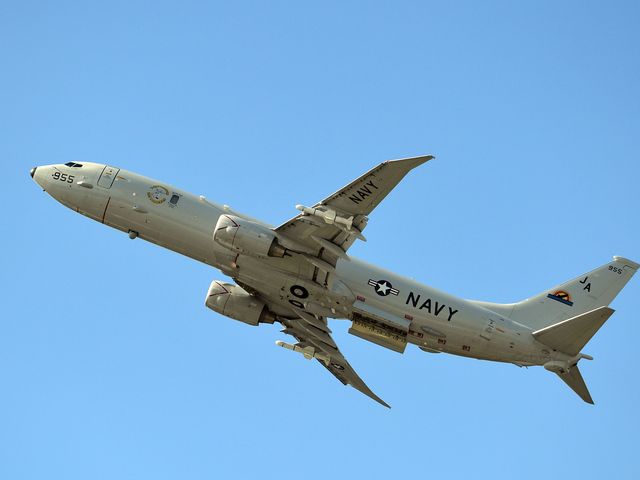
Some Stunning HD Photos of "Boeing P-8 Poseidon" Maritime Patrol & Anti-Submarine Warfare Aircraft (All Types)


1st Boeing P-8I Maritie Patrol Aircraft Arrives In India


Indian Navy to receive 2 more P-8Is by end of 2013  

SEATTLE, May 15, 2013 – The first Boeing [NYSE: BA] P-8I long-range maritime reconnaissance and anti-submarine warfare aircraft arrived today, on schedule, at India Naval Station Rajali. The P-8I is one of eight aircraft Boeing is building for India as part of a contract awarded in 2009.   

“Boeing is proud to deliver this advanced aircraft to meet the Indian Navy’s unique maritime patrol requirements,” said Chris Chadwick, president of Boeing Military Aircraft. “The P-8I team, which includes our customer and Indian suppliers, has done a fantastic job working together, and we’re on track to deliver the next two P-8I aircraft later this year."

Based on the Boeing Next-Generation 737 commercial airplane, the P-8I is the Indian Navy variant of the P-8A Poseidon that Boeing is developing for the U.S. Navy. The P-8I incorporates not only India-unique design features, but also India-built subsystems that are tailored to the country’s maritime patrol requirements.

Boeing P-8A Poseidon_Long-range Anti-submarine Aarfare, Anti-surface Warfare, Intelligence, Surveillance and Reconnaissance Aircraft


The P-8A Poseidon is a long-range anti-submarine warfare, anti-surface warfare, intelligence, surveillance and reconnaissance aircraft. It possesses an advanced mission system that ensures maximum interoperability in the future battle space. Capable of broad-area maritime, and littoral operations, the P-8A will influence how the U.S. Navy's maritime patrol and reconnaissance forces train, operate and deploy.

Nowhere to Run, Nowhere to Hide

The P-8A Poseidon is a true multi-mission platform. On board P-8A, all sensors contribute to a single fused tactical situation display, which is then shared over both military standard and internet protocol data links, allowing for seamless delivery of information amongst U.S. and coalition forces. As an armed platform, P-8A independently closes the kill chain, while simultaneously providing data to everyone on the network.

In-line Production

The P-8A is the latest military derivative aircraft to benefit from a culture of technical innovation and the One Boeing approach to manufacturing. The P-8A is a derivative of the highly successful and reliable Next-Generation 737. The P-8A has the fuselage of a 737-800 and the wings of a 737-900. Modifications to the baseline commercial aircraft are incorporated into the aircraft in-line. In the past, commercial aircraft were sent to modification centers where they were taken apart and rebuilt to meet military specifications. The P-8A is Boeing's first military derivative aircraft to incorporate structural modifications to the aircraft as it moves through the commercial line.

Customers

Boeing's team is developing the P-8A Poseidon for the U.S. Navy, which plans to purchase 117 aircraft. As part of the flight test program, the Navy will have three P-8As at Naval Air Station Patuxent River, Md., in 2010. Initial operational capability is scheduled for 2013. In January 2009 Boeing was selected to provide eight P-8I long-range maritime reconnaissance and anti-submarine warfare aircraft to the Indian navy. India is the first international customer for the P-8. Boeing believes there are numerous other opportunities for international sales to countries currently operating P-3s or similar maritime patrol aircraft. Interest has been expressed by many countries including Australia and Italy.

The Poseidon Industry Team

The P-8A is being developed by a Boeing-led team that consists of CFM International, Northrop Grumman, Raytheon, GE Aviation and Spirit AeroSystems.
An industry leader in large-scale systems integration, Boeing provides unrivaled expertise in customizing military and commercial products for maritime forces. Boeing is completing final assembly of the P-8A in Renton, Wash., taking advantage of the proven efficiencies, manufacturing processes and performance of the existing Next-Generation 737 production system.
CFM International supplies the CFM56-7 engine that powers the P-8A.
Northrop Grumman provides the directional infrared countermeasures system and the electronic support measures system.
Raytheon provides the upgraded AN/APY-10 maritime surveillance radar and signals intelligence solutions.
GE Aviation supplies flight-management and stores-management systems.
Spirit AeroSystems builds the 737 aircraft's fuselage and airframe tail sections and struts.

Milestones

  • Since the System Development and Demonstration contract was awarded to Boeing in 2004, the P-8A Poseidon program has been a model acquisition program.
  • First flight -- 2009
  • First flight test aircraft to Naval Air Station Patuxent River, MD. -- 2010

Australia to Buy More P-8 Poseidon


Boeing Maritime Jet Gains Favor in Australia, Paring Drone Need
Australia plans to buy more Boeing Co. (BA:US) P-8 Poseidon maritime patrol jets than initially projected to replace planes dating from the 1970s, reducing its requirement for drones built by Northrop Grumman Corp. (NOC:US)
Funding for the purchase will be sought next year, with talks under way about the exact mix of P-8s and MQ-4C Triton unmanned aircraft, the head of the Royal Australian Air Force, Air Marshal Geoff Brown, said in an interview in London.
Australia currently uses 18 Lockheed Martin Corp. (LMT:US) AP-3C Orions upgraded a decade ago to hunt submarines, monitor ship traffic and aid in rescue missions, with some planes also deployed in combat operations in Iraq and Afghanistan. While it had planned to acquire eight aircraft and seven drones, the number of P-8s could now reach into double figures, Brown said.
“We are making an argument that a larger number of P-8s would be better,” he said. “I am not looking for more dollars, I am just looking at where we spend the money.”
While the P-8 -- a Boeing 737 airliner modified to carry gear that can detect submerged submarines, drop torpedoes and fire weapons -- is more capable than the AP-3C, wider global demands mean a substantial fleet is required, Brown said.
The shift in thinking toward P-8s, currently operated by the U.S. Navy and Indian air force, doesn’t mean drones such as the Triton, a version of the U.S. Air Force’s Global Hawk that’s also used by the U.S. Navy -- are out of favor, he said.
“I’m still a great supporter of unmanned air systems,” Brown said, adding that the Triton, while lacking weapons, would be able to monitor far greater areas than an aircraft.
JSF ‘Confidence’
Brown said he also expects the RAAF to examine requirements for smaller drones once operations in Afghanistan cease, to be purchased outright or under a fee-for-service arrangement.
Australia deploys Israel Aerospace Industries Ltd. Heron unmanned aircraft in that role and may replace them with larger Heron-TPs, also built by the Tel Aviv company, or Reaper drones from San Diego-based General Atomics Aeronautical Systems Inc.
Among other impending orders is one for Lockheed Martin’s F-35 Joint Strike Fighter, of which Australia has bought 14 of 72 it plans to take with the aim of reaching operational status by 2020, two years before Boeing Co. F/A-18 Hornets are retired.
The country has acquired 24 newer F/A-18E/F Super Hornets as a gap filler, while planning to add 12 EA-18G Growlers -- a version of the same aircraft used for electronic warfare.
Additional Super Hornet purchases are unlikely given “increasing confidence” in the F-35 schedule, Brown said.
The initial JSFs will establish three combat squadrons and a training unit, and Australia retains a long-term objective of fielding 100 of the planes, with an order decision likely after 2020 when the Super Hornets will need retiring or upgrading.
Brown said that while he’s a backer of the F-35, he’s frustrated by delays in arming the plane with an anti-ship weapon, regarded as central to Australian requirements.
“A maritime strike missile is an important weapon for us,” he said. “If there was any part of the program I have been disappointed with it has been the slowness to address the maritime strike weapon.”