June 18/13: Boeing & Embraer. Embraer and Boeing sign an agreement to market Embraer’s KC-390
medium airlifter in limited international venues, building on the June
26/12 MoU. Boeing will be the lead for KC-390 sales, sustainment and
training opportunities in the USA, UK and “select Middle East markets.”
Outside the Middle East, that doesn’t actually encompass a lot of meaningful... {click to expand +}
Keep reading for the whole story with recent events put in context

Upgraded F-5EM
Could the words “Brazilian fighter” begin evoking images unrelated to
the Gracies? Recent boosts to Brazil’s defense budget could be on its
way to accomplishing that and more. The Navy and Army have already
received funds to replace broken-down equipment, and new fighters will
be a critical centerpiece of the Forca Aerea Brasileira’s efforts.
Boeing’s F/A-18 E/F Super Hornet, France’s Dassault’s Rafale, Saab’s JAS-39 Gripen NG
were picked as finalists. But after repeated stalling, the question is
whether Brazil will actually place an order, or fold up the competition
like the ill-fated 2011 F-X process.
This free-to-view DID Spotlight article covers Brazil’s reborn F-X2
competition, adds its assessment of the competitors’ relative strengths
and weaknesses, and covers ongoing events.
F-X2: FAB Foreshadowing

Brazil
(click to view full)
Brazil can depend on its sheer size, and the barrier created by its
geography, to shield its population centers from many threats. The same
isn’t necessarily true of its military installations or economic
interests, which require either air superiority, or air denial from
mobile and effective defensive missiles. Airpower’s flexibility also
makes it a uniquely useful as a deterrent and response to threats and
coercion, and is uniquely suited to the job of patrolling vast areas.
Much of that patrol work falls to the mid-tier of Brazil’s its air
force, and its specialty fleets. Those are in good shape, which makes
sense in a region where most threats are internal. Brazil’s 43 or so upgraded
Brazilian-Italian AMX subsonic light attack jets, and 99 indigenous
Super Tucano COIN/surveillance turboprops, are quality offerings within
their respective niches. Their performance is very well suited to basic
policing duties, especially when backed by a small but advanced set of
airborne, ground looking and maritime R-99/ P-99 radar derivatives of
Embraer’s ERJ-145 business jets. The ERJ derivatives will be augmented
by 12 refurbished P-3 Orions, bought to patrol Brazil’s huge coastlines
and maritime economic zone.
Unfortunately, the high end of the FAB’s fighter fleet is inferior even when judged by regional standards.
After its existing Mirage IIIs simply wore out and had to be retired
at the end of 2005, FAB Command worked out a plan to find an emergency
interim replacement. The final choice was 12 second-hand French Mirage
2000Cs. The airframes selected by Brazil were produced for France
between 1984 -1987, and began arriving in Brazil in 2006.
A parallel F-5 upgrade program
is underway to keep those 1960s-era lightweight fighters in service for
another 15 years, while modernizing them to a level of effectiveness
that’s slightly below the Mirages.

FAV SU-30MK2
(click to view full)
Inducting 20 year old aircraft was not a long-term solution.
Especially for a country that reportedly had about 37% of its 719-plane
air force grounded, due to a combination of age and the toll of Brazil’s
environments. Upgrading the F-5s is useful, but can’t even be described
as a short-term solution to the gap at the high end of their force.
Meanwhile, Venezuela’s large military buys, and especially its FAV’s
recent purchase of long-range, 4+ generation SU-30MK2 fighters,
appear to have had the effect of triggering counter moves around Latin
America. So, too, have Venezuela’s actions around Latin America, as the
line between external and internal threats blurs. In Brazil’s case,
interference within key Brazilian natural gas provider Bolivia was not
seen as a friendly act.
Publicly, Brazil has been careful to stress that this is not about an
arms race. Defense Minister Nelson Jobim said in a 2007 public speech
that:
“Brazil has well established, peaceful relations with all
South American nations … one of our political priorities is economic
and structural integration of the region … (and in 2008) we’ll also be
strengthening our military links… [Brazil cannot] neglect its defense.
Therefore, we will increase our budget outlays and investment in the
army, navy and air force by more than 50 percent… [Brazil] is
elaborating a national strategy defense plan that will determine each
military branch’s mission and the equipment it needs for its
activities”.
The reassurances are meant to be sincere. So, too, are the plans
referred to in the second half of the quote. Brazil has shaken off its
sloth and taken wide-ranging steps to revive its military. Including its
fighters.
In January 2008, Brazil’s President Lula authorized Brazilian Air
Force Commander Juniti Saito to restart the long-delayed F-X fighter
replacement program. “F-X2″ aimed to acquire 36 next generation fighters
for the Brazilian Air Force. A previous 2001 F-X competition was put on
hold in 2003, and then canceled in February 2004 due to budget
difficulties and political issues. The initial budget for the current
iteration is said to be $2.2 billion, but is likely to end up being
2x-3x that figure. The RFP leaves the door open for future buys, which
could raise that total to 120 aircraft.
F-X2: The Industrial Angle

AMX light fighter
(click to view full)
President Lula da Silva’s administration had larger plans than just
equipment recapitalization when it took those steps, saying that “we
must overcome the lack of strategic planning and the technological
dismantling of the last two decades.” The new National Defence Strategy
group is designed to plan and execute the recovery of the “capability of
our armed forces and the technological edge we once had in certain
fields.”
Brazil maintained an impressive niche capability during the 1970s and
1980s in areas like tank and armored vehicle design, rockets, missiles,
and of course aircraft. Unfortunately, in a world divided by cold war
allegiances, there was often little room for a non-aligned 3rd party
exporter. While some projects like the Tucano succeeded, and others like
the AMX enjoyed qualified success, many promising projects saw limited
exports or failed.
The world is no longer divided into cold war camps, which may offer
the Brazilian defense industry a second chance if it partners well and
executes smartly. According to the main guidelines of the da Silva’s
long term strategy, Brazilian defense industry should look to become a
player again in the export of missiles, aircraft and other equipment.
UAVs, with their long endurance surveillance capabilities and natural
connection to Brazil’s aviation industry, are likely to also become a
priority. The overall thrust of Brazil’s policies is certainly clear:
“We must convince ourselves that we can become a world power this
century,” said President Lula da Silva.

Military Review, 1999
(click to view full)
On the one hand, these statements remind one of the old joke that
goes: “Brazil is the nation of the future – and always will be.”
On the other hand, anteing up with a 50% hike to the defense budget
certainly displays seriousness, and Brazil has already set up a key
partnership to develop the 5th generation A-Darter short range air-air
missile with South Africa. A similar deal with Israel for its Derby/Alto
radar guided missile is also expected at some point, and RFPs went out
for a handful of medium transport helicopters (AW EH101, Russian
Mi-171V, EADS EC725 – which won) and some attack helicopters (AW-TAI A129, EADS Tiger, Russian Mi-35M – which won).
The giant may be stirring again. A handful of fighters and
helicopters, plus ships to patrol its coasts, won’t exactly make anyone a
world power. Budgetary resources will also have to address an urgent
need for transport aircraft, which is pushing resources toward Embraer’s
KC-390. Still, these buys may go a long way toward ensuring the
nation’s ability to patrol and enforce its long borders. The right deals
may also allow Brazil to re-establish its faded indigenous defense
industry on the world stage.
While the January 2011 suspension of the F-X2 competition is a
setback for Brazilian industry, and for Brazil’s ability to safeguard
the nation’s borders, it doesn’t stop this defense industrial drive. In
the air, Embraer’s KC-390 medium transport has become a serious contender for global orders, even as the EC725 partnership
with Eurocopter is giving Brazil much-improved helicopter manufacturing
and servicing. The A-Darter missile program is ongoing, and on the
ground, a major partnership with Iveco will produce hundreds of VBTP 6×6 wheeled armored personnel carriers. Cooperation with France will produce 5 submarines,
including 1 nuclear attack sub; and a major naval tender to buy
frigates, patrol vessels, and supply ships has attracted bids from Britain, Korea, France, and elsewhere. A clever buy of 3 Scarborough Class 90m patrol boats from BAE, with options to build 5 more in Brazil, has begun that process.
F-X2: The Competition

Dassault Rafale:
Takeoff at last?
(click to view full)
The 36+ aircraft under consideration for F-X2 were mostly the same
set of 4+ generation fighters that were considered for the canceled F-X
competition: Boeing’s F/A-18 E/F Super Hornet, Dassault’s Rafale, EADS’ Eurofighter, Lockheed Martin’s F-16 Block 60, Saab’s JAS-39 Gripen NG, and Sukhoi’s SU-35.
The FAB was also said to be interested in the Lockheed-Martin F-35,
but the finalized nature of the Lighting’s industrial production
partnership program was likely to keep the program from delivering the
industrial offsets Brazil seeks. Meanwhile, a pair of competitors from
earlier rounds faded out. Dassault’s Mirage 2000 production line was
closing, and Brazil did not mention the F-16 as a contender – or advance
Lockheed Martin’s F-16BR Block 70 offer to the finals.
Reporter Tania Monteiro of the Brazilian newspaper O Estado de Sao
Paulo writes that technology transfer will be an essential part of any
deal, and quotes influential Workers’ Party Deputy (PT is Lula’s party,
Deputy = MP or Congressman) Jose Genoino as saying:
“France is always the better partner. Concerning Russia,
everyone knows the difficulties and we don’t know what is going to
happen in ten years so that we will be able to guarantee our spare
parts. The USA, traditionally, does not transfer technology… We want to
seek the lowest price with the most technology transfer.”
If his assessment of Brazil’s priorities remains true, that country
could represent a critical last chance for France to get some export
momentum and success behind its Rafale, which has lost every competition
it has entered thus far (Morocco, Netherlands, Norway, Saudi Arabia,
Singapore, South Korea, UAE, et. al.). To win, France will need to come
up with a strong package. According to reports, the indications are that
technology transfer will be more important than cost in terms of the
final choice. Defence minister Nelson Jobim:
“Whatever the final contract it must be closely linked to
national development, to help advance in the creation of a strong
defense industry and therefore the technological edge we are
requesting.”
Analysis: F-X2 Competitors
Some quick handicapping follows. The F-X2 finalists are Saab’s JAS-39
Gripen, France’s Rafale, and Boeing’s F/A-18E/F Super Hornet; but if
the competition is re-started, new possibilities will present
themselves. Beyond the air force, the Marinha do Brazil eventually
intends to buy 24 fighters of its own, to operate from the carrier that
replaces NAe Sao Paulo beginning in 2025. They’re watching the
competition closely, and would prefer to buy the same aircraft.
Saab JAS-39 Gripen NG

Gripen: air show
(click to view full)
Pros: The JAS-39 Gripen Next Generation program
offers key industrial opportunities, along with a high-performance
fighter whose price and operating costs are both low. Gripen is likely
to be Brazil’s cheapest option over its service life. The JAS-39BR’s
avionics suite will be sourced entirely from Elbit’s Brazilian
subsidiary AEL, giving it commonalities with the FAB’s other fighters.
JAS-39BRs would also give Brazil’s Air Force a fast integration track
for the cooperative A-Darter
air-air missile that Brazil is developing with JAS-39C/D customer South
Africa, and deploying on its own modernized A-1M AMX fighters.
Saab offers strong industrial partnerships, and has a record of successful technology transfer agreements.
Grey Areas: The JAS-39 NG includes the Raven AESA
radar developed with Selex Galileo, whose long history with Brazil’s FAB
includes the F-5BR (Grifo-F) and AMX (Scipio) fighter programs. The
Raven is an unusual combination of an AESA radar that can be
mechanically pivoted, offering more points of failure but widening the
radar’s scanning cone versus other competitors. That’s a strong plus,
but the Raven isn’t as tested and proven as the AESA radars equipping
the Super Hornet and Rafale.
Brazil combines vast over-water areas and even vaster wilderness
areas to patrol, which usually translates into a focus on range and
2-engine safety. While the other 2 Brazilian finalists are both 2-engine
planes, it’s worth noting that most of Brazil’s other fighters (Tucano
ALX, AMX, Mirage 2000) have just one engine. The F414 engine that Gripen
shares with the Super Hornet offers the advantages of certain
performance and a broad long-term customer base, but it’s subject to US
export approvals if that’s an issue for Brazil.

Gripen NG Demo
(click to view full)
Weaknesses: Saab’s biggest handicap is the industrial and geopolitical weight of its rivals from France & the USA.
Another handicap involves its lack of a naval variant, or even a
flying prototype of same. Conversion of land-based aircraft for naval
aviation is often unrealistic, but Sweden’s insistence on short take-off
and landing performance from surfaces like highways gives Gripen a
strong base to work from. Saab began serious work on a “Sea Gripen” in
March 2011, and could offer Brazilian industry the unique opportunity to
be involved in developing the modified aircraft in time for 2025. It’s
still a weakness, but it’s a weakness with a hook that might prove
attractive.
Offer: The JAS-39NG reportedly ranked 1st in the
FAB’s technical trials, had strong support from Brazilian aerospace
firms, and offered a complete package worth about $6 billion (about 10
billion Reals), of which $1.5 billion was for maintenance. Saab has even
begun working with a number of Brazilian firms in advance of any
contracts, discussing sub-contracting possibilities, and working to
improve their industrial proficiency with key technologies like advanced
composite materials.
Dassault’s Rafale F3R

FAB Rafale-B concept
(click to view full)
Pros: The Rafale has a lot of advantages in this
competition. It’s a twin-engine fighter with good range and ordnance
capacity, and much better aerial performance than the F/A-18 Super
Hornet. It can also play the carrier-compatible card very well, since
the NAe Sao Paulo was once FS Foch, and Brazil’s next carrier may well
be a variant of DCNS’ PA2 design.
It also comes from a trusted supplier. Experience with the Mirage
2000 offers a common technological and training base, and France is seen
as a good supplier who avoids political interference and makes good on
technology transfers. Brazil is already embarked upon a broad set of
major defense projects with French firms, and President Lula’s
administration clearly favored the Rafale as part of that relationship.

Rafale-M
(click to view full)
Grey Areas: Thales new RBE2-AA AESA radar has been
installed in French Air Force fighters, so it’s mature by the barest of
margins, but it hasn’t been used in combat.
The Rafale confines Brazil to French weapons and sensors, unless
Brazil spends its own money to add some locally-developed ordnance. On
the other hand, Brazil has bought French Mirage aircraft a few times
before, and seems unfazed by that requirement. Offers to partner in
expanding the Rafale’s options might serve to hit 2 targets at once, by
allaying concerns and playing the tech transfer card more strongly.
The Rafale’s January 2012 pick as India’s preferred fighter softens
the type’s biggest negative, but India hasn’t signed a contract yet. The
Rafale remains the only plane in this competition without an existing
export customer, and it has lost a lot of international competitions.
Weaknesses: The Rafale’s biggest performance
weakness is its lack of a Helmet Mounted Display, which keeps it from
reaching its full potential in close-range air combat. Its biggest
contest weakness is probably its price.
Offer: Subsequent events would bear out both the
Rafale’s strengths, and its weaknesses. Folha de Sao Paolo reports that
it was the most expensive of the 3 finalists, with a price tag of about
$8.2 billion US dollars (13.3 billion Reals), plus $4 billion in
maintenance contracts over the next 30 years. Dassault reportedly
offered the best technology transfer package, and Defence Minister Jobim
claims a subsequent $2 billion price reduction, but details remain
unclear. The plane remains a strong contender, and may yet win.
F/A-18E/F Super Hornet

F/A-18E, Parked
(click to view full)
Pros: The Super Hornet’s biggest advantage is a huge
user base, with guaranteed future funding for upgrades that Brazil
won’t have to invest in to benefit from. The Block II’s combat-proven
AN/APG-79 AESA radar offers Brazil an attractive technology, volume
production lets Boeing start at a price comparable to the single-engine
JAS-39′s, a weaker American dollar makes American exports even more
affordable, and the potential to turn these planes into EA-18 electronic jamming fighters
is a unique selling point for the type. The Super Hornet shares the
carrier-compatible card with Dassault’s Rafale, but it offers a much
wider range of ordnance to choose from.
Boeing’s passenger aircraft division gives them an attractive magnet
for industrial offsets, and in April and June 2012, Boeing strengthened
its position by signing a broad cooperation deal with Embraer. Their
offering will use wide-screen displays and some other avionics from
Elbit’s Brazilian subsidiary AEL.
Grey Areas: The Super Hornet is an American jet, and
the vast majority of its equipment and weapons are also American. The
USA’s influence in Latin America can help their lobbying, but their
image in Latin America can hurt them at the same time. Much will depend
on what kind of relationship Brazil has with Washington around the time
the decision is made, and where they want that relationship to go.
The other grey area for the Super Hornet is technology transfer and
customization. Exactly how much technology Boeing and the US government
are willing to transfer isn’t clear, though they promise that their
offer is competitive. Source code transfer is a related point, and it
affects the ease with which Brazil will be able to add its own equipment
if the Super Hornet is chosen.
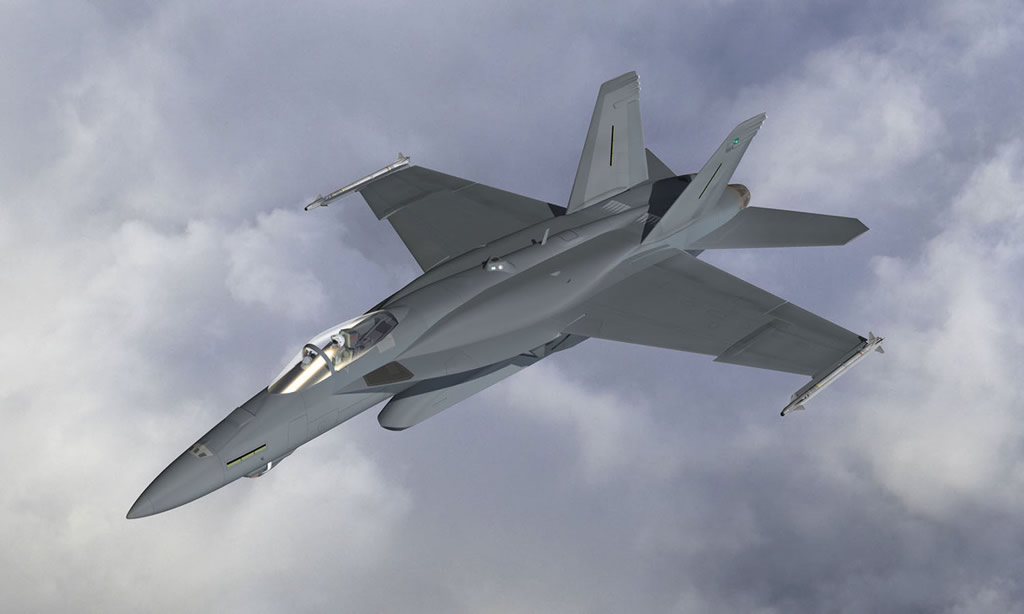
F/A-18E International
(click to view full)
Weaknesses: The Super Hornet offers poorer
aerodynamic performance than other competitors, falling behind in areas
like maneuverability, acceleration, sustained Gs, etc. Concerns about
America’s propensity to use arms export bans as a political lever add a
final complication to the Super Hornet’s odds, and take away some of the
advantage created by its broad arsenal of American weapons and sensors.
Offer: After being the long-shot finalist for most
of this competition, heavy lobbying by the US government and Boeing
appears to have put the Super Hornet back in the running. Folha de Sao
Paolo reports that Boeing’s package was worth $7.7 billion dollars
(about 12.9 billion reals), of which $1.9 billion was for maintenance.
Rousseff has reportedly pressed Boeing to improve its industrial
participation offer. Sen. McCain reportedly pledged to get a
Congressional commitment that the US Congress would not block the sale
or transfer of technologies, but that cannot be binding, which would
leave the issue of future spare parts interference etc. as an open
question. There have been reports that Rousseff is interested in moving
Brazil closer to the USA in the international arena. If they are true,
that could make a big difference to the Super Hornet’s chances.
Non-finalists

RAF Typhoon & ASRAAM
(click to view full)
Eurofighter Typhoon (EADS/European): Technology
transfer may prove to be an issue, but price was always the biggest
stumbling block. Eurofighters consistently sell for $110-130 million,
which doesn’t square well with $2.2 billion for 36 planes. The most
capable air-air choice in the group would provide unquestioned regional
air superiority, but ground surveillance and strike performance is still
provisional (Tranche 1 v6), or unproven (Tranche 2+). This has been
fatal in competitions like Singapore’s, and may have been a handicap
here.
On the plus side, EADS Airbus offered a potent option for industrial
offsets, and other EADS subsidiaries had footholds of their own. Airbus
Military’s A400M medium transport
may create additional military interest in a long term industrial
partnership, and EADS Eurocopter’s Cougar has just become the
medium-lift mainstay of Brazil’s future helicopter fleet.

X-35B STOVL
(click for landing)
F-35 Lightning II/ F-16BR (Lockheed Martin) The F-35
would have offered a clear set of performance benefits over competing
aircraft. No aircraft in this group could have matched the Lightning’s
advanced surveillance capabilities, and surveillance is a big need in
Brazil. The F-35B STOVL variant also offered Brazil the ability to
operate from small, dispersed runways, and it would have been perfect
for aircraft carriers like the Sao Paulo. Unfortunately, technology
transfer issues weren’t the F-35′s only problem. Other barriers to an
F-35 win included limited opportunities in its industrial structure,
questions surrounding air-air performance, the low likelihood of
deliveries before 2016 (a concern that was more than vindicated by
events), a single engine design – and the potential cancellation of the
F-35B variant, which would be most useful to Brazil.
Instead, Lockheed Martin offered Brazil an F-16BR. It was expected to
resemble the F-16E/F “Block 70″ variant offered to India, with an AESA
radar and built-in IRST/targeting sensors, an uprated engine, etc. Both
India and Brazil are fond of Israeli avionics and weapons, and Lockheed
Martin has a long history of including those items for Israel and for
other customers.
The F-16BR offer shareed many of the Super Hornet’s perceived
benefits and drawbacks: AESA radar and sensors and weaker American
dollar on the plus side, poorer aerodynamic performance and distrust of
America on the minus side. The F-16 cannot play the carrier-compatible
card like the Super Hornet, and offers only a single-engine design. On
the other hand, it did offer wide compatibility with other regional and
global air forces.

SU-35
(click to view full)
SU-35 (Sukhoi/ Rosoboronexport) This was the
aircraft Russia offered in the last round, and the design has matured
into a production aircraft since then. Russian tech transfer is trusted.
Lack of political interference is trusted absolutely. The aircraft
itself would offer an option that’s better than Venezuela’s SU-30MKs,
while still presenting itself to the region as an equivalency move. The
price would be good, and Sukhoi had some support in the FAB.
On the other hand, service and parts delivery were almost guaranteed
to be bad. That gave the FAB real pause. One way around that might be to
offer licensed local production. In order to solve the Russian service
problem[1],
it would also have to extend to the aircraft’s NPO Saturn engines and
fitted avionics. In the end, it didn’t matter. The SU-35S was not a
finalist.
Contracts and Key Events
2013
Gripen would use AEL avionics suite; Sukhoi’s unsolicited offer; Boeing deepens Embraer ties.

Sea Gripen Concept
(click to view full)
June 18/13: Boeing & Embraer. Embraer and Boeing sign an agreement to market Embraer’s KC-390
medium airlifter in limited international venues, building on the June
26/12 MoU. Boeing will be the lead for KC-390 sales, sustainment and
training opportunities in the USA, UK and “select Middle East markets.”
Outside the Middle East, that doesn’t actually encompass a lot of
meaningful opportunities, but it’s one more factor bolstering Boeing’s
F-X-2 bid. Boeing  | Embraer.
May 20/13: SU-35, unsolicited. RIA Novosti quotes
Rosoboronexport’s SITDEF exhibition lead Sergey Ladigin, who says
they’ve offered to deliver Su-35 fighters and Pantsir S1 air defense
systems to Brazil outside the framework of a tender, and says the offer
is being considered.
Brazil wants the Pantsir short-range air defense gun/missile systems,
but the SU-35 failed to make the shortlist in 2009. On the other hand,
if you don’t ask, you’ll never get. So Russia’s is throwing in the Su-35
offer, and Ladigin said in Lima that they were “ready to transfer 100%
of manufacturing technologies,” as well as some technologies from their
T50 (future SU-50?) stealth fighter. Russian Aviation .
May 15/13: Sea Gripen. Saab remains serious about
its “Sea Gripen NG,” and has been working on the idea since their May
2011 announcement. Brazil’s Navy is expected to buy its own fighters to
equip a new aircraft carrier, which is expected to replace NAe Sao Paulo
around 2025. They expect their 24 new fighters to be the same type as
the FAB’s F-X-2 winner, which leaves Saab competing against 2 proven
naval fighters: Boeing’s F/A-18 Super Hornets and Dassault’s Rafale-M.
To help build their case, former Brazilian naval aviator Comte.
Romulo “Leftover” Sobral is invited to flight test a JAS-39D, in order
to verify the design’s basic suitability for naval conversion. Sobral
liked the aircraft’s intuitive flight controls, ground handling,
stability at low airspeeds, acceleration response, handling at the high
angles of attack used in carrier landings, and good visibility. He even
liked the flight suit. The plane landed in 800m, and Comte Sobral
believes that the plane does have the basic requirements to become an
effective naval fighter. The Sea Gripen’s lack of proven status, and
absence of even a flying prototype, will still hurt the JAs-39. On the
other hand, the time lag from F-X2 to a naval buy gives Brazilian
industry a unique opportunity to participate in designing the Sea
Gripen. Saab Gripen Blog | Full article at Defesa Aerea & Naval [in Portuguese].
April 15/13: Rafale. Defense World reports
from LAAD 2013 that Dassault’s F-X2 offer will be the Rafale F3R, which
includes a major software upgrade that allows the aircraft to take
fuller advantage of the new Thales RBE2-AA AESA radar, improves their
Thales SPECTRA self-defence systems, adds Mode-5/Mode-S capable
Identification Friend or Foe, and allows the Rafale to deploy MBDA’s
Meteor long range air-to-air missile.
Given Brazil’s insistence on an AESA radar, Dassault could hardly avoid offering the F3R.
April 10/13: Gripen. Saab executive Eddy de la Motta
is quoted as saying that Brazilian JAS-39 Gripen NGs would use AEL’s
avionics, creating a forked version under the wider development effort.
This will help Saab meet industrial offset obligations, and also create
commonality for Brazil’s fighter fleet, but integrating all of those
components with the plane’s mission computers, OFP core software,
weapons, etc. is not a trivial task. Elbit subsidiary AEL’s avionics are
used in many Brazilian aircraft, with the exception of the Mirage 2000s
that will retire as F-X2 fighters enter the FAB.
A less comprehensive suite of AEL avionics will also be used in
Boeing’s F/A-18 International, which offers AEL’s wide-screen display
and some other components to all potential customers. Defense News .
April 3/13: Embraer. Embraer’s CEO Luiz Carlos Aguiar talks to Defense News about F-X2 and other subjects. Regarding the fighters:
| Embraer.
May 20/13: SU-35, unsolicited. RIA Novosti quotes
Rosoboronexport’s SITDEF exhibition lead Sergey Ladigin, who says
they’ve offered to deliver Su-35 fighters and Pantsir S1 air defense
systems to Brazil outside the framework of a tender, and says the offer
is being considered.
Brazil wants the Pantsir short-range air defense gun/missile systems,
but the SU-35 failed to make the shortlist in 2009. On the other hand,
if you don’t ask, you’ll never get. So Russia’s is throwing in the Su-35
offer, and Ladigin said in Lima that they were “ready to transfer 100%
of manufacturing technologies,” as well as some technologies from their
T50 (future SU-50?) stealth fighter. Russian Aviation .
May 15/13: Sea Gripen. Saab remains serious about
its “Sea Gripen NG,” and has been working on the idea since their May
2011 announcement. Brazil’s Navy is expected to buy its own fighters to
equip a new aircraft carrier, which is expected to replace NAe Sao Paulo
around 2025. They expect their 24 new fighters to be the same type as
the FAB’s F-X-2 winner, which leaves Saab competing against 2 proven
naval fighters: Boeing’s F/A-18 Super Hornets and Dassault’s Rafale-M.
To help build their case, former Brazilian naval aviator Comte.
Romulo “Leftover” Sobral is invited to flight test a JAS-39D, in order
to verify the design’s basic suitability for naval conversion. Sobral
liked the aircraft’s intuitive flight controls, ground handling,
stability at low airspeeds, acceleration response, handling at the high
angles of attack used in carrier landings, and good visibility. He even
liked the flight suit. The plane landed in 800m, and Comte Sobral
believes that the plane does have the basic requirements to become an
effective naval fighter. The Sea Gripen’s lack of proven status, and
absence of even a flying prototype, will still hurt the JAs-39. On the
other hand, the time lag from F-X2 to a naval buy gives Brazilian
industry a unique opportunity to participate in designing the Sea
Gripen. Saab Gripen Blog | Full article at Defesa Aerea & Naval [in Portuguese].
April 15/13: Rafale. Defense World reports
from LAAD 2013 that Dassault’s F-X2 offer will be the Rafale F3R, which
includes a major software upgrade that allows the aircraft to take
fuller advantage of the new Thales RBE2-AA AESA radar, improves their
Thales SPECTRA self-defence systems, adds Mode-5/Mode-S capable
Identification Friend or Foe, and allows the Rafale to deploy MBDA’s
Meteor long range air-to-air missile.
Given Brazil’s insistence on an AESA radar, Dassault could hardly avoid offering the F3R.
April 10/13: Gripen. Saab executive Eddy de la Motta
is quoted as saying that Brazilian JAS-39 Gripen NGs would use AEL’s
avionics, creating a forked version under the wider development effort.
This will help Saab meet industrial offset obligations, and also create
commonality for Brazil’s fighter fleet, but integrating all of those
components with the plane’s mission computers, OFP core software,
weapons, etc. is not a trivial task. Elbit subsidiary AEL’s avionics are
used in many Brazilian aircraft, with the exception of the Mirage 2000s
that will retire as F-X2 fighters enter the FAB.
A less comprehensive suite of AEL avionics will also be used in
Boeing’s F/A-18 International, which offers AEL’s wide-screen display
and some other components to all potential customers. Defense News .
April 3/13: Embraer. Embraer’s CEO Luiz Carlos Aguiar talks to Defense News about F-X2 and other subjects. Regarding the fighters:
“I think [the decision is] going to be in the next
months, this year, I would say. Our role in that depends… on who is
going to win. We have a memorandum of understanding with all three of
the contenders. Each of them offers an offset program, but we prefer not
declaring publicly our preference…. Whatever they choose, we’re going
to be in the process. They need to make this decision because Brazil
needs that…. With the F-X, we can even go further in terms of
technology, and even some new products could come up with one of these
three contenders. That’s what I can tell you, I can’t go further than
that.”
Given Embraer’s dominant position in the Brazilian aerospace
industry, it would be shocking if any of the contenders had chosen not
to sign industrial partnership MoUs with Embraer. In light of the April
and August 2012 agreements, the “new products” comment suggests that
Boeing may have replaced Saab (q.v. Sept 28-29/09 entries) as Embraer’s
preferred choice. That isn’t at all certain, however – as Aguliar surely
intended. Defense News .
March 8/13: More delays. Brazil has asked the 3 F-X2
finalists to extend their bids for another 6 months from the March
30/13 deadline, as the Brazilian commodity economy remains mired in a
2-year slump. Boeing, Dassault, and Saab has hoped for a decision in
time for Brazil’s April 2013 LAAD defense expo.
The length of the cumulative delays could create changes for the
bids, and it effectively squashes any faint hopes that the new jets
would be able to fly in time for the 2014 World Cup. Given required
production and training times, those hopes started to become awfully
faint by around mid-2012. Reuters .
2012
Rafale wins in India; Boeing trying hard.

Rafale
(click to view full)
Dec 11/12: Still no deadline. In a joint press
conference with French President Hollande, Brazil’s President Rousseff
remains very non-committal regarding F-X2. On the one hand, the timing
will depend on Brazil’s economy, which is commodity based and so subject
to the effects of global slowdowns. On the other hand, she says that
the government expects enough growth in the coming months to resume the
selection process. French President [in French] | YouTube press conference video | Les Echos [in French].
Dec 7/12: Super Hornet. The Brazilian news weekly
Istoe publishes an article claiming that the FAB’s formal analysis had
preferred Boeing’s F/A-18E/F Super Hornets. The report was shelved by
the government, which favored France’s Rafale. The air force’s
preference is reportedly due in part to the fact that the Super Hornet
has the widest variety of integrated weapons and equipment, and partly
because it’s available immediately and could be delivered very quickly.
The FAB is reported to be concerned about both the age of its fleet, and
its regional competitiveness.
The Super Hornet’s cost was in the middle, at $5.4 billion rather
than the Gripen’s $4.3 billion, or Rafale’s $8.2 billion. So, too, were
estimated operating costs, at about $10,000 per flight hour vs. $7,000
for Gripen, or $20,000 for the Rafale.
The government’s thinking is still opaque, though Boeing’s technical
cooperation agreements with Embraer (vid. April 3-9/12 and June 26/12
entries) add a bit more weight to the industrial side of the equation. Istoe [in Portuguese, and note that their picture is an F-15] | Defense World .
Aug 9/12: Delayed, again. Brazil may need a 5th consecutive extension. Defence Minister Celso Amorim tells Dow Jones that:
“The project is not being abandoned. There will be a
decision in the right time. But, today, I would prefer not to give a
date… The economic situation has taken a less favorable turn than
expected and it naturally requires caution.”
With China’s economy appearing to slow, and the EU debt crisis as an
ongoing drag on their economy, a commodity-based economy like Brazil
could find itself in tight straits for a while unless something changes.
Fox News .
July 7/12: Extension. The FAB has asked the 3
bidders to renew their fighter offers. It’s the 4th consecutive 6-month
extension, while Brazil dithers over its choice and the timing of the
buy. France24 .
June 26/12: Boeing & Embraer. Boeing and Embraer
announce an agreement to share some specific technical knowledge
regarding the KC-390, and to evaluate markets where they may join their
sales efforts for medium-lift military transports. It’s part of a
broader agreement signed in April 2012 (vid.), and its immediate
significance is limited.
On the other hand, it has the potential to turn Boeing into a medium
transport rival to C-130 maker Lockheed Martin, while extending
Embraer’s marketing reach to match Lockheed Martin and Airbus. That’s
the sort of thing that could change the KC-390′s global prospects, but
it’s still too early to tell. Boeing | Embraer .
June 14/12: Boeing & AEL. Boeing picks Elbit
Systems and its AEL Sistemas subsidiary to provide a low-profile head-up
display (LPHUD), as part of the Advanced Cockpit System for Boeing
fighter jets. This follows the March 5/12 pick to supply the ACS’ Large
Area Display (LAD) offered as an option for new F/A-18 Super Hornets and
F-15s, including the F-15SE Silent Eagle. Boeing .
May 19/12: 2012 decision? Mercopress reports
that Rousseff’s government intends to make its F-X2 decision by the end
of 2012. That’s a good way to reduce those tiring lobbying meetings.
April 3-9/12: Boeing & Embraer. Boeing announces
its new Sao Paulo facility, Boeing Research & Technology-Brazil. It
is the firm’s 6th global advanced research center, after Europe,
Australia, India, China and Russia. Areas of research focus for the new
center will include sustainable aviation biofuels (Brazil is a leading
biofuel producer), advanced air traffic management, advanced metals and
bio-materials, and support and services technologies.
That announcement is followed by a broad business agreement with
Embraer to cooperate in these areas, as well as in commercial aircraft.
The broader announcement by Embraer and Boeing was made on the same day
as the signing by the Brazilian and United States Governments of a
Memorandum of Understanding on the Aviation Partnership, to expand and
deepen cooperation between the 2 countries on civil aviation. Boeing re: facility | Boeing re: cooperation .
March 5/12: Boeing & AEL. Boeing Company and
Elbit Systems announce a Memorandum of Understanding (MOU) to cooperate
in Brazil. As part of the MoU, Elbit has committed to investing in its
AEL Sistemas S.A. subsidiary. Elbit’s 11″ x 19″ Large Area Display has
already been picked for next-generation F/A-18 Super Hornet and F-15
Eagle variants & upgrades, and the implication is that AEL would
help develop and integrate this capability in any Brazilian F/A-18 Super
Hornets.
Per Elbit’s investments, AEL will participate in LAD software &
hardware development, and establish an Advanced Cockpit Technology
Center of Excellence in Brazil. They’re already the Brazilian military’s
top avionics supplier, and the firm hopes to expand its cockpit
avionics market reach to other fixed-wing and helicopter platforms. Boeing .
Feb 10/12: Reuters reports
that Boeing has frozen its 2009 bid price, as the same price for any
new tender. In effect, it’s a price reduction of the cost of inflation
over that time; the Reuters article offers estimates of a 12% real
discount.
Jan 31/12: Rafale in India. Dassault’s Rafale is picked as India’s preferred plane for its 126+ plane M-MRCA fighter contract. A subsequent article
in India’s newspaper The Hindu, by Brazilian Prof. Oliver Stuenkel,
notes that Brazilian defense minister Amorim’s recent trip to India,
immediately after the Rafale had been picked, included an agreement “to
share with Brazil some of its experiences of carrying out the open
tender evaluation to select the best aircraft… The big question now is
how the decision to have Brazil study documents about India’s selection
process will affect the tender process in Brazil.”
2012
F-X2 put in limbo, but maneuvering continues; Minister Jobim resigns; Sea Gripen started.

Training for what?
(click to view full)
Dec 21/11: Boeing announces
Memoranda of Understanding (MOUs) with MSM Powertrain Ltda. (logistics
services, ground support equipment, engineering support) and Pan Metal
Industria Metalurgica Ltda. (assembly, subsystem installation, machined
parts, processing, heat treatment) to explore work opportunities with
Boeing and its industry partners if Boeing wins F-X2. MSM and Pan Metal
join more than 25 other companies throughout Brazil that Boeing and its
industry partners have already identified.
Sept 30/11: Brazil’s new Defense Minister Celso Amorim says that:
“By the end of 2013, none of the 12 Mirage (aircraft) at
the Anapolis air base will be in full flying condition. This [fighter
buy] is something that is really urgent, very important… The need to
defend the Amazon, the borders – We need to have adequate combat
aircraft…”
He reiterated Brazil’s position that the “transfer of technology” is
the key sticking point, but earlier comments from Brazil’s government
indicate that a larger sticking point may involve the parlous and
unstable state of the global economy. If the EU’s inability to enforce
its membership terms triggers a global economic crisis, Brazil may find
it difficult to field the fighters it needs. AFP | TheLocal.se (note that Saab the carmaker is not Saab aerospace).
Sept 22/11: MercoPress reports
that Brazilian Foreign Minister Antonio Patriota has given French
President Sarkozy a possible 2012 date to resume F-X2 – but that comes
with a large caveat:
“Depending on the evolution of the global economic
situation, if the crisis turns out to be less severe than some imagine,
then those plans can resume next year.”
Aug 5/11: Personnel is policy. Brazilian defense
minister Nelson Jobim is forced to resign, after public reports of
critical comments concerning fellow ministers. He’s the 3rd minister to
resign since President Rousseff took office in January 2011, which is
creating strains in her governing coalition.
Mr. Jobim will be replaced by the former Foreign Minister, Celso
Amorim. Amorim is a high profile figure. Some have called him
anti-American, but Wikileaks cables
suggest that this may have been a reaction to the activities of other
figures in his department. It remains to be seen if, and how, his
selection may affect the fighter competition. Mercopress | BBC | Amorim July 2011 interview , incl. video.
July 20/11: Boeing holds an industry forum in Brazil to outline opportunities available as part of the company’s F/A-18 Super Hornet offering.
May 24/11: Sea Gripen starts development. A Saab Group release states that Saab AB will open new UK headquarters and a new Saab Design Centre in London. The engineering center:
“…will capitalise on the UK’s maritime jet engineering
expertise and is scheduled to open in the late Summer. Initially staffed
by approximately 10 British employees, its first project will be to
design the carrier-based version of the Gripen new generation multi-role
fighter aircraft based on studies completed by Saab in Sweden.”
Sea Gripen was initially pushed for India (q.v. Dec 28/09 entry), but
with Gripen out of M-MRCA unless something changes, the likely target
would appear to be Brazil’s suspended F-X2 program.
May 18/11: Saab. Official opening of the Swedish –
Brazilian centre of research and innovation (Centro de Inovacao e
Pesquisa Sueco-Brasileiro, CISB) in Sao Bernardo de Campo, Brazil, which
grew out of the Saab CEO’s September 2010 visit to Brazil. So far, the
centre has attracted over 40 partners from academia and industry, who
will be active partners in the specific projects. Areas of focus will be
in Transport and Logistics, Defence and Security, and Urban development
with a focus on energy and the environment.
Saab President & CEO Hakan Buskhe cites a coastal surveillance
radar project with Atmos and a datalink development project with ION as
examples, and the firm sees many opportunities in Brazil beyond the
Gripen project. Civil security will get special attention, as Brazil is
hosting both the FIFA World Cup and Olympic Games within the next few
years. Saab Group .
Feb 22/11: U.S. deputy assistant secretary of
defense for Western Hemisphere affairs, Frank Mora, stands by the
technology transfer offer made to Brazil in the event of an F/A-18 Super
Hornet buy, calling it “a significant technology transfer” that “would
put Brazil at par with our close partners.” The question is whether the
Brazilians will consider that enough, if an when they make a decision. UPI .
Feb 20/11: Agence France Presse :
“Major daily O Estado de Sao Paulo cited four unnamed
government ministers as saying new President Dilma Rousseff saw no
“climate” for the acquisition in 2011, and that such a move in the midst
of a $30-billion slash in the year’s budget would be an
“inconsistency.”
Jan 17/11: President Rousseff leaves the F-X2
competition in limbo, in light of concerns about the financing of the
purchase, how much to borrow for the initial fighter purchase, and
inter-agency disagreements. The exact commitment is a decision later in
2011, but no contract until 2012. In practice, however, there is no firm
timeline or deadline for a decision, and domestic spending priorities
loom large in Rousseff’s agenda. Which makes this a de facto suspension.
If it is a suspension, it leaves the situation of every contender in
play. Rousseff has said she wishes to re-open the arguments between the
air force (Gripen preferred) and the ministry (Rafale preferred), via an
inter-ministerial group, and also wishes to open a dialogue with
industry. Both of those moves would have the effect of adding weight to
Saab’s bid. She has also reportedly pressed Sen. John McCain [R-AZ] to
secure a clear written commitment that the U.S. Congress would not veto
the transfer of technology and fighter components, and has reportedly
pressed Boeing to improve its industrial participation offer. There have
been reports
that Rousseff is interested in moving Brazil closer to the USA in the
international arena. If they are true, that could make a big difference
to the Super Hornet’s chances. Folha de Sao Paolo [in Portuguese] | Defense News | Defense Update | Flight International || Americas Society (AS-COA) | Bloomberg | BusinessWeek re: Rafale program overall | Le Figaro [in French] | Reuters | UPI .
2010
FAB’s (revised?) evaluation in; Controversy in Brazil; Lula won’t sign a contract before he leaves office.

Rafale: Takeoff?
(click to view full)
Dec 6/10: End of F-X2? Brazilian President Luiz
Inacio Lula da Silva confirms that he won’t sign a fighter deal before
he leaves office. An excerpt published by state news agency Agencia
Brasil said:
“It’s a very big debt, it’s a long-term debt for Brazil. I
could sign off on it and do a deal with France, but I’m not going to do
that…”
A number of analysts expect his successor, former Marxist guerilla Dilma Rousseff ,
to cancel the program altogether. With inflation beginning to rear its
head in Brazil, Brazil’s Finance Minister Guido Mantega is promising a
program of government spending cuts, in order to help deal with it.
Unfortunately, the used Mirage 2000s that Brazil bought are unlikely to
last much beyond 2014, and French officials remain confident – in
public, at least. Agence France Presse | Bloomberg | DefenseWorld | Sweden’s The Local | Reuters || Folha de Sao Paolo [Portuguese, subscription].
Dec 1/10: Saab inaugurates
a new Swedish-Brazilian research and innovation center in São Bernardo
do Campo, Brazil, with a 2-day workshop. The center’s main foci include
aerospace, defence and urban innovation/ civil security. Saab will work
in close co-operation with local industry and universities including
UFABC (Universidade Federal do ABC) and FEI (Centro Universitário da
FEI), per a 2009 bilateral Government agreement to extend innovative
high technological industrial co-operation between Brazil and Sweden.
Nov 3/10: Brazilian President Luiz Inacio Lula da Silva says that:
“We are going to talk over the issue of the fighters –
me, [his successor and lieutenant Dilma Rousseff] and [Defense Minister
Nelson] Jobim.”
The clear implication is that Rousseff’s win will lead to Brazil
confirming Lula’s pre-evaluation choice, and picking the Rafale. Agence France Presse .
April 7/10: AFP reports that Brazilian prosecutors
have agreed to open an inquiry into the F-X2 competition, with
prosecutor Jose Alfredo de Paulo Silva approving the request from an
opponent of Lula’s, who complained that:
“The Brazilian government, because of external political
factors, has decided to choose the Rafale, ruling out the Gripen and
Super Hornet which were put forward at a lower price. That is against
economic principles…”
A spokesman for Brazil’s interior ministry reportedly told AFP the
prosecutor would now gather information, and decide if a civil case was
possible, and said the inquiry could take up to a year. President Lula’s
term ends in January 2011, however, and the election is set for October
2010, so even a 6-month delay would leave the fighter decision for
Lula’s successor. See Jan 11/10 entry for the implications of that
change.
Other reports quote Defense Minister Nelson Jobim, who says that
Brazil’s air force prefers France’s Rafale jet despite the plane’s
higher price tag, on industrial grounds. They also indicate that Lula
intends to take his proposal to the defense council in the first half of
May 2010, with an official decision expected soon after. A competition
that is already very political, is becoming even more so. AFP | Avio News | Expatica | Usine Nouvelle [in French].
March 19-25/10: O Estado de Sao Paolo reports that
the Brazilian air force certified all 3 fighter jet finalists as meeting
Brazil’s technical specifications, and says that relevant reports have
been delivered to the defense ministry. Brazil’s defense ministry said
it would release final details during the week of April 5/10.
During a subsequent meeting with Sweden’s King Carl XVI Gustaf on
March 25th, President Lula is quoted as saying that he’s waiting for the
“definitive” technical report on the contenders. Saab CEO Aake Svensson
reportedly told the Swedish news agency TT that the Gripen had come out
on top in the Brazilian air force’s price and technical evaluation, but
previous reports in this competition have been left “unfinalized” and
then changed for political reasons. Agence France Presse | UPI | China’s People’s Daily .
March 9/10: Brazilian President Luiz Inacio Lula da
Silva claims in his weekly column that his government hasn’t made a
decision yet on Brazil’s next fighter aircraft. That’s unlikely to be
believed. Associated Press .
Feb 24/10: Agence France Presse says that Brazil’s government has officially denied a Folha de Sao Paulo report re: revised bids from the 3 competitors.
If that unsourced report is accurate, the Rafale’s price dropped from
$8.2 billion to $6.2 billion, plus another $4 billion dollars in
maintenance over the next 3 decades. The JAS-39NG Gripens were
reportedly priced at $4.5 billion dollars plus $1.5 billion dollars in
maintenance, while the F/A-18 E/F Super Hornets would reportedly cost
$5.7 billion plus $1.9 billion in maintenance.
Jan 11/10: An unidentified Brazilian cabinet member tells Reuters
that President Lula will choose the French-made Rafale jet as Brazil’s
next-generation fighter plane, but wants to negotiate a lower price.
In the background, the political clock is ticking. Lula is
constitutionally required to step down after 2 terms in office, and the
election to succeed him is set for October 2010. If a deal cannot be
done before then, Lula’s successor may have less invested in extending
Brazil’s defense partnership with France. Given the apparent preferences
within industry and the air force, that could change the likely
favorite in an unfinished F-X2 competition.
Jan 8/10: Brazil’s Estadao de Sao Paulo says that
the official Air Force report has been modified. It reportedly no longer
ranks the 3 finalists, treats the strengths of the Rafale and F/A-18
Super Hornet fighters as established, treats the Gripen NG’s strengths
as developmental, and emphasizes the advantages of a twin-engine
fighter. With the F/A-18 E/F apparently a political non-starter, it’s
expected that these changes will lower the barriers to selecting
France’s Rafale. As President Lula intends. Estadao de Sao Paulo | defense-aerospace translation .
Jan 5/10: The Brazilian air force’s Comissao
Coordenadora do Programa Aeronaves de Combate (FAB COPAC) has produced
its technical evaluation, based on aircraft performance, purchase and
lifetime costs, and industrial benefits. The report was ratified by FAB
command on December 18th, and media reports from the Folha de Sao Paulo
claim that FAB’s executive summary had Saab’s Gripen as the preferred
choice, with Boeing’s Super Hornet in 2nd place, and the Rafale last.
The final decision will be President Lula’s, but despite a MdD
statement that the report has not been formally delivered, it’s likely
to raise the political cost of going ahead with the Rafale deal. The
dates involved also shed new light on the government’s mid-December 2009
decision to postpone their final decision, as FAB commander Brigadier
Juniti Saito was with Defense Minister Jobim on end-of-year trips to
China, Ukraine, and Paris, and COPAC Brigadier Dirceu Tondolo Noro was
reportedly called to join them in Paris at the last minute.
Lifetime cost is a very significant issue for the FAB, which
understands the inevitable swings that accompany military budgeting in a
commodity-driven economy. Saab claims a price of around $70 million
(currently around EUR 50 million), which would be 60-70% of the Rafale’s
offer price, depending on which sources one believes. Dassault has sort
of denied that the Rafale would be 40-50% more expensive (q.v. Nov
12/09 entry), and also contests Saab’s claim that the Gripen NG’s
operating and maintenance cost per flight-hour would be just 25% of the
twin-engine Rafale’s, but the French firm has not publicly offered any
detailed figures. In terms of the politicians’ most important benchmark,
the FAB also reportedly gave Gripen NG the edge in industrial benefits,
siding with Brazilian industry in believing that a project in
development offers greater opportunities to expand Brazilian
technologies and skills than a finished product like the Rafale. FAB release [Portuguese] | Folha de Sao Paulo [Portuguese] | Poder Aero [Portuguese or Google's amusing auto-translation ] | Reuters .
2009
Lula picks Rafale before tests are in; F-X2 decision postponed;
Bids & revised offers submitted; Gripen’s AESA radar partnership;
Super Hornet DSCA request; Does Brazilian industry favor the Gripen?

Gripen Demo rollout
(click to view full)
Dec 28/09: Sea Gripen. Reports confirm that
co-development of a carrier-capable “Sea Gripen” design was part of
Saab’s response to India’s M-MRCA fighter competition RFI, adding that
Brazil’s future fighter requirements were also targeted. Key changes are
outlined, and Gripen VP of Operational Capabilities Peter Nilsson tells
StratPost that the Sea Gripen is intended for both CATOBAR (Catapult
Assisted Take Off But Arrested Recovery) as well as STOBAR (Short Take
Off But Arrested Recovery – “ski jump”) operations:
“There will obviously be differences in the MTOW (Maximum
Take-Off Weight). In a CATOBAR concept, the Sea Gripen will have a MTOW
of 16,500 kilograms and a maximum landing weight of 11,500 kilograms.
In a STOBAR concept it depends on the physics of the carrier. Roughly,
the payload of fuel and weapons in STOBAR operations will be one-third
less than the payload in CATOBAR operations. There will be no
differences in ‘bring-back’ capability,” he says.”
See: StratPost | Gripen India
Dec 15/09: FX-2 Postponed. Brazilian President Lula da Silva elects to postpone the F-X2 decision until the spring. MercoPress | UPI .
Nov 18/09: A small political kerfuffle erupts as 9
ex-Assistant Secretaries of State for the Western Hemisphere send a
letter to Sen. George LeMieux [R-FL] and Senate Republican leader Mitch
McConnell, asking LeMieux to join Sen. Jim DeMint [R-SC] in lifting his
hold on career diplomat Thomas Shannon’s nomination as Ambassador to
Brazil. This is a fairly common practice by both parties, and it takes
only 1 senator to place a hold on key nominations. This often leaves key
posts unfulfilled for long periods of time.
The letter says that Boeing’s efforts to sell its F/A-18F to Brazil
will be placed at risk by the continuing lack of an accredited
ambassador. That probably won’t help, but a long history of restrictive
American arms export policies, and the fact that the fix appears to be
in at top levels to expand defense industrial cooperation with France,
are both far more consequential. Bloomberg News .
Nov 12/09: France’s Dassault hits back at its
competitors, sort of. Dassault’s Brazilian subsidiary of the French
company held a hastily called news conference in Brasilia to defend the
aircraft, and sort of deny reports of a 40% higher price than the lowest
bid.
Dassault executive Jean-Marc Merialdo would not offer figures, or
even deny the reports directly. He did say that claims the Rafale was
more expensive by such a margin were “unfounded” and asserted that it
was “comparable to other aircraft of the same class.” Defense News .
Oct 4/09: Bids in. Brazil’s FAB confirms that
revised bids are in from all 3 short-listed contenders, and Saab’s offer
clearly has significant support from the Swedish government.
Gripen International’s revised bid offers a wide range of elements,
including: Full involvement in the Gripen NG development program;
Complete technology transfer and national autonomy through joint
development; Independence in choice of weapons and systems integration;
Production in Brazil of up to 80% Gripen NG airframes, via a full Gripen
NG assembly line; and Full maintenance capability in Brazil for the
Gripen NG’s F414 engine. That last offer would largely remove the threat
of future American interference, and it would be interesting to see how
Gripen International proposes to achieve it. Gripen International touts
“significantly lower acquisition, support and operating costs” for its
plane, and all this would be backed by a firm proposal for full
long-term financing from the government’s Swedish Export Credit
Corporation.
The additional offers are equally significant. Brazil will have the
sales lead for Gripen NG in Latin America, with joint opportunities
elsewhere. Saab would join the KC-390 program
as a development and marketing partner, and Sweden will evaluate the
KC-390 for its long term tactical air transport needs, as a future
replacement for its recently-upgraded
but aging C-130 Hercules aircraft. Saab also proposes to replace
Sweden’s aged fleet of about 42 SK60/ Saab 105 jet trainers with
Embraer’s Super Tucano, but it received a SKr 130 million ($18.8 million) deal
in September 2009 to upgrade the planes’ cockpit systems, and current
Swedish plans would see the SK60s continue in service until mid-2017. FAB release [in Portuguese] | Gripen International release.
Sept 29/09: Who, us? Embraer release [PDF format]:
“Regarding the article published in the Valor Econômico
newspaper, dated September 28, 2009, Embraer clarifies that it is not
directly participating in the selection process of the new F-X2 fighter
for the Brazilian Air Force and, contrary to what was stated, it has no
preference among the proposals presented. Embraer reaffirms its
unconditional support of this process, always in close alignment with
Brazil’s Aeronautics Command and the Ministry of Defense.”
Sept 28/09: Embraer drops a political bombshell,
when Embraer’s Deputy Chief Executive for the defense market, Orlando
Jose Ferreira Neto, tells Valor Economico that the firm was asked to
advise the Air Force re: industrial proposals, and concluded that
participating in the JAS-39NG Gripen’s development offers Brazil’s
aerospace industry the best long-term benefits. Embraer reportedly saw
the JAS-39NG as offering the opportunity to participate in the design
process, rather than just producing parts. The opinion is a shock, as
France’s interest in buying Embraer’s KC-390 transports was expected to
leave Brazil’s top aerospace firm solidly on-side for the Rafale bid.
T-1 Holdings executives (see Sept 17/09 entry) were also quoted in the
article.
In response, Defence Minister Jobim fires back to say that the government will make these decisions, not Embraer. Dow Jones | Defense Aerospace translations (note: links will not last) | Valor Online , via Noticias Militares [in Portuguese] | Defesa Brazil [in Portuguese] | O Globo [in Portuguese].
Sept 17/09: Saab announces
that over 20 engineers from the Brazilian firms Akaer, Friuli, Imbra
Aerospace, Minoica, and Winnstal are already working on the Gripen NG
project in Linkoping, Sweden, with the Swedish government’s
authorization. The 5 firms will participate as the T1 holding, and would
be responsible for projecting and manufacturing the JAS-39BR’s central
and rear fuselages and wings. If all goes well, Akaer predicts that as
of 2010 a team of at least 150 engineers and technicians from the T1
holding will start working in Brazil, alongside 20 Swedish specialists.
Beyond Gripen production, the holding’s goal is to form a new
Brazilian aeronautical center in Brazil, and some technology transfer in
the area of composite materials is reportedly underway already. Shaping
the wing of a supersonic craft requires higher quality levels than
civil applications, as well as manufacturing challenges owing to thicker
and more resistant parts. Management and integration training within a
holding structure of this type will also be required.
Sept 15/09: Boeing kicks off a 2-day conference in
Sao Paulo with 140 potential partner and supplier companies, as it
reaffirms its Super Hornet offer in advance of the Sept 21/09 submission
date. Bob Gower, vice president of the Boeing F/A-18E/F Program stated
openly that the Super Hornet’s price “is considerably lower than that of
the Rafale.” Boeing’s release also addresses reports of incomplete technology transfer for its product:
“Boeing delivered an offer to the Brazilian Air Force in
August that included full technology transfer… [defined as] the option
of Super Hornet co-production in Brazil and the sharing of technology
that would allow Brazil to integrate its own weapons.”
Sept 14/09: MercoPress reports
remarks by CGT union leader Dominique Richard at Dassault, who is
concerned about the extent of technology transfer that may be offered.
Dassault, meanwhile, denies that there will be any effect on French
jobs. Richard:
“There’s something which troubles us in this contract and
is the fact that Brazil wants to have its own military air industry and
that the agreement with Dassault, the French government and the
Brazilian government includes the transfer of technology.”
See also AnsaLatina [in Spanish].
Sept 13/09: Flight International’s “Closer political ties raise prospects for renewed alliance between Dassault and Embraer ” covers the market possibilities.
The 2 firms have very little overlap. Dassault is strong in the
high-end executive jet market, but Embraer brackets those offerings with
bigger regional jets and lower-end Phenom light and very light jets.
Some form of consolidation could make sense. Embraer is also looking to
field competition with the Boeing 737 and Airbus A319/320 series, and
could benefit from Dassault’s engineering expertise. On the flip side,
the KC-390 tactical transport would add a new product category for
Dassault, improving and eventually replacing the Rafale could take a
wider set of resources than France and Dassault are willing to supply,
and the closure of the Mirage 2000 line leaves a hole in Dassault’s
offerings at the light end of the spectrum.
Sept 11/09: Brazil’s MdD announces a Sept 21/09
deadline for Dassault to submit its Rafale business proposal, adding
that the other 2 firms can also choose to submit. Defense Minister
Nelson Jobim is quoted as saying [translated]:
“Now we have to evaluate the proposals. The commitments
that President Sarkozy made will have to be confirmed by Dassault’s
offer… there has been a political decision of the President to expand
the strategic alliance with France… for this policy decision to come
into effect, it depends on Dassault and also the others, because there
needs to be a comparative evaluation.”
The Brazilian air force (FAB) still expects to complete the technical
review process by the end of October 2009, for delivery to the Minister
of Defense and the President. The final decision will be the
President’s – and Lula has already expressed his clear preference,
unless Dassault does something to change it via adverse pricing and
financing terms or issues with technology transfer. “>MdD release & defence aerospace translation | Folha de Sao Paolo re: tech transfer [in Portguese].
Sept 9/09: …or not. Aftermath, and clarifications.
Brazil’s President and MDD reaffirm their intended defense partnership
with France, while the US Embassy correctly notes – and Brazil’s MdD
confirms – that no formal decision has been taken yet. This is
technically true, but there is no question that the Rafale has been
given preferred bidder status. Negotiations would have to fail badly
before any other contender had a chance. The Brazilian newspaper Folha
de Sao Paolo:
“The expectation is that the deal will be concluded with
France, but only if it offers a lower price for the Rafale, the most
expensive of the competitors, and a more favorable interest rate.
According to [reporting by] Folha de Sao Paulo, Lula rushed into dinner
with Sarkozy on Sunday night and skipped several steps of the selection
process, which angered the Air Force Command and left Jobim in the
crossfire.”
There are also widespread reports that Brazil’s unwillingness to be
subject to the USA’s potential ITAR restrictions and technology transfer
limits was a key factor in their rejection of the F/A-18 E/F Super
Hornet, and of Saab’s JAS-39 Gripen NG (whose F414 engine is American). Brazilian President’s Office | MDD clarification | US Embassy in Brazil | Folha de Sao Paolo & translation via defense aerospace | Gripen International confirms its continued participation.
Sept 7/09: Winner!? Brazil’s Ministerio Da Defesa
announces that Dassault Aviation is now the F-X2 competition’s preferred
bidder, and the country will order 36 Rafales subject to further
negotiations. The announcement also says that Brazil has secured French
cooperation to develop Embraer’s KC-390 medium transport, and possibly
buy 10-12 of the aircraft when they’re introduced.
This sale would be France’s 1st export order for its Rafale fighter,
after numerous attempts spanning more than a decade. French technology
transfer across a broad range of projects was reportedly the critical
factor in the deal, and Brazilian Foreign Minister Celso Amorim
reportedly said that the decision to begin talks with Dassault “was not
adopted in relation to the other two” competing companies. President
Luiz Inacio Lula da Silva, meanwhile, described the move as
“definitively consolidating a strategic partnership we started in 2005.”
Brazil will now produce helicopters (EC725), submarines
(nuclear-powered and diesel-electric), transport aircraft (KC-390) and
possibly fighters (Rafale) in cooperation with France, under a broad
strategic partnership in the defense arena. MDD announcement [Portuguese] | Agence France Presse | France24 | CS Monitor | L.A. Times | Reuters .
Sept 5/09: Brazil’s Defesa@NET explains the expected way forward:
“A Brazilian military expert who runs a specialist
magazine titled Defesanet, Nelson During, told AFP that Brazil’s
decision should be known in October. “The air force should send its
evaluation of the three aircraft to the government on October 23 — Day
of the Aviator — indicating its choice. Then, the National Defense
Council should ratify that choice pretty quickly,” he said.”
Sept 3/09: Brazil’s Defesa@NET refers
to an exclusive interview that Agence France Presse conducted with
Brazilian President Luiz Inacio Lula da Silva, and offers key quotes:
“A country of Brazil’s importance cannot buy a product
from another country without technology transfer… France has shown
itself to be the most flexible country in terms of transferring
technology, and evidently, this is an exceptional comparative advantage…
France is the only important country ready to discuss with us
technology transfers in all these domains [helicopters, submarines, and
fighter jets]… Brazil has drawn up a strategic defense plan. We are
convinced … that because of the Amazon, our deep-water offshore oil
deposits, Brazil should have a defense industry in keeping with its size
and import.”
Aug 21/09: The Brisbane Times covers stepped up lobbying in Brazil, as the decision date is reportedly pushed from September to October 2009.
Aug 6/09: F/A-18 filing. Per US laws, the Defense Security Cooperation Agency (DSCA) announces
[PDF] Brazil’s formal request to buy up to 36 F/A-18E/F Super hornets
and related equipment. The DSCA release is careful to stress that Brazil
has yet to select its future fighter; the notice simply gives Brazil
full assurance that all aspects of the sale can proceed smoothly if the
Super Hornet is selected. This may be why no estimated cost has been
given – a departure from DSCA norms.
Industrial offset agreements associated with this proposed sale are
expected, but would be defined during negotiations between the purchaser
and contractor. The equipment would include:
- 28 F/A-18E Super Hornet Aircraft,
- 8 F/A-18F Super Hornet Aircraft
- 76 F414-GE-400 installed engines: 72 installed, 4 spares
- 36 AN/APG-79 AESA Radar Systems
- 36 M61A2 installed 20mm Gun Systems
- 44 Joint Helmet Mounted Cueing Systems (JHMCS)
- 144 LAU-127 Launchers
- 28 AIM-120C-7 Advanced Medium Range Air-to-Air Missiles (AMRAAM)
-
28 AIM-9M Sidewinder short range air-air missiles. AIM-9M is the most
common current version in US service, but not the most advanced; that
distinction belongs to the AIM-9X. Brazil is collaborating with South
Africa on the A-Darter SRAAM, which is intended to be an AIM-9X peer.
- 60 GBU-31/32 Joint Direct Attack Munitions (JDAM)
- 36 AGM-154 Joint Standoff Weapon (JSOW) precision glide bombs
-
10 AGM-88B HARM anti-radar missiles. Brazil produces its own missile,
but the HARM is already integrated with the Super hornet and Brazil’s
weapon is not.
- 36 AN/ASQ-228v2 Advanced Targeting Forward-Looking Infrared (ATFLIR) surveillance and targeting pods.
- 36 AN/ALR-67v3 Radar Warning Receivers
- 36 of BAE’s AN/ALQ-214 Radio Frequency Countermeasures systems
- 40 of BAE’s AN/ALE-47 Electronic Warfare Countermeasures systems
- 112 AN/ALE-50 Towed Decoys
-
Plus the Joint Mission Planning System, support equipment, spare and
repair parts, personnel training and training equipment, ferry and
tanker support, flight test, software support, publications and
technical documents, and other support.
The principal contractors were listed as:
- The Boeing Company St. Louis, MO (Super Hornets, JDAM)
- General Electric Aircraft Engines in Lynn, MA (F414-400)
- Northrup Grumman Corporation El Segundo, CA (Super Hornets)
- Raytheon Corporation El Segundo, CA (ATFLIR pods, APG-79 radar, AGM-88, JSOW, AIM-120, AIM-9, ALE-50 towed decoys)
- Lockheed Martin in Bethesda, MD
Implementation of this sale will require approximately 8 contractor
representatives to provide technical and logistics support in Brazil for
2 years. U.S. Government and contractor representatives will also
participate in program management and technical reviews for 1-week
intervals twice semi-annually.
July 13/09: MercoPress reports that deals are in the works between F-X2 contenders and Brazilian companies.
According to MercoPress, Boeing IDS President & CEO Jim Albaugh
said agreements have been signed with 27 Brazilian companies that are
capable of producing parts for the F/A-18, including Embraer. The move
could reportedly translate into 5,000 jobs throughout the entire supply
chain.
Saab Gripen’s marketing chief Bob Kemp was reportedly quoted as
saying that Gripen International was prepared to shift up to 50% of
future production to Brazil.
The report adds that Brazilian President Lula da Silva has invited
French President Sarkozy to its independence day celebrations on
September 7th, as a guest of honor. Da Silva reportedly said that he
hopes to sign new defence accords at that time. This is taken by some as
an indication that Dassault’s Rafale is currently the favored
candidate. France is Brazil’s most significant defense supplier on a
broad range of fronts, however, and so the promise of new accords is not
definitive.
May 4/09: Revised offers. Brazil’s FAB(Forca Aerea
Brazileira) issues a release, announcing that revised offers from the
participating companies were submitted to F-X2 Project Management
(GPF-X2). The companies are listed, and it’s the same list as the
finalists and original submissions listed on Feb 2/09: Boeing, Dassault,
and Saab. No Russian firms listed.
GPF-X2 has held clarification meetings held since March 2/09. On
March 30/09, it began verification visits to see the firms’ facilities,
maintenance, R&D labs, and active squadrons; and will make
evaluation flights. FAB release [in Portuguese]
April 6/09: Russia’s RIA Novosti quotes Alexander Fomin, deputy director of Russia’s Federal Service on Military-Technical Cooperation:
“We are actively participating in the Brazilian tender,
which has been reopened. It involves over 100 fighter planes. Russia has
made a bid in the tender with its Su-35 multirole fighter. The tender
has stiff requirements, involving not only the sale, but also the
transfer of technology. It is a key condition of the deal and Russia is
ready to satisfy it… We are discussing with the well-known Brazilian
company Embraer the transfer of technology and the construction of
facilities for the future licensed production of the aircraft…”
Fomin reportedly added that such a facility could also produce the
5th generation PAK-FA fighter being developed in conjunction with India.
Experiences with the American F-22 and F-35 suggest that this would
depend on the sophistication of the facilities. Stealth fighters require
new equipment and techniques that go beyond normal aircraft
construction standards, and a facility set up to produce even 4+
generation fighters may not be adequate.
March 30/09: The Brazilian Air force announces
[in Portuguese] that it is beginning visits and technical evaluation of
the 3 finalists. This evaluation will include test flights, and
evaluation of the bids’ technical, industrial and maintenance offerings.
March 24/09: Gripen AESA. Dassault’s acquisition of a
large stake in Thales led to Thales’ refusal to sell Saab the RBE2-AA
AESA radar beyond the Gripen Demo stage. In response, Saab and SELEX
Galileo sign an agreement to develop an Active Electronically Scanned
Array (AESA) radar for the JAS-39NG. The arrangement is initially aimed
at Brazil’s fighter competition, where it leverages Selex Galileo’s
strong pedigree equipping Brazil’s F-5BR fighters (Grifo-F radar) and
AMX light attack jets (Scipio radar). Once integrated and proven,
however, the AESA upgrade would be available to any Gripen customer.
Per Aviation Week’s March 10/09 report
from Aero India, the radar will use a Vixen 500 AESA front end, with
“back end” modules from the existing PS-05/A. Using those back end
modules simplifies integration, and also avoids the control issues
inherent in American alternatives. As it happens, the 2 firms have a
long history of radar partnerships. Ericsson (now Saab’s) partner on the
original PS-05/A was Ferranti, which became GEC-Marconi, then BAE
Systems, and now Selex Galileo. Selex was also Saab’s partner in the recent M-AESA R&D project.
The Vixen 500 AESA radar is currently used in the USA by border surveillance aircraft , but it has yet to see service on a fighter. Korea’s F/A-50
was recently barred from using the Vixen 500E, under an agreement with
co-developer Lockheed Martin that did not allow the F/A-50′s
capabilities to surpass the ROKAF’s F-16s. Saab | Gripen International .
Feb 2/09: Bids are in. Boeing confirms that it has submitted a bid involving 36 F/A-18 Super Hornet Block IIs, with the APG-79 AESA radar.
Gripen International confirms a bid involving 36 JAS-39NG aircraft,
with longer range, AESA radars, and other enhancements. Their release
adds that Brazil will have “direct involvement in the development,
production and maintenance of the platform but it will also generate
transfer of key technology including access to Gripen source codes.”
It is presumed that Dassault also submitted a 36-plane bid for its Rafale fighter. Boeing release | Gripen International release .
2007 – 2008
F-X2 program revived; RFP out; 3 finalists picked.

FAB Mirage 2000s
(click to view full)
November 2008: Russia and Brazil sign a series of
agreements on military technology cooperation. As is customary, the
agreements set out protocols for the protection of intellectual property
rights and technology secrets, which make joint ventures and local
production easier to manage. Source .
Oct 30/08: RFP. Brazil’s FAB formally issues the RFP
to the short-listed competitors. The 3 firms will have until Feb 2/09
to present their proposals, which must include operational, logistic,
industrial, commercial, technical, commercial compensation (offset) and
technology transfer details. FAB release [Portuguese].
Oct 1/08: Finalists picked. Brazil has decided on
its 3 finalists: Boeing’s F/A-18E/F Super Hornet, Dassault Aviation’s
Rafale, and Saab/BAE’s JAS-39 Gripen.
EADS Eurofighter, Lockheed Martin’s F-16BR, and Sukhoi’s SU-35 all failed to make the cut. Brazilian FAB release [Portuguese] | Reuters | Boeing release | Gripen International release .
Aug 27/08: Defesanet reports that Lockheed Martin
will be offering an F-16BR for Brazil’s F-X2, rather than the F-35. The
report adds that barriers to technology transfer of some F-35 systems
played a role in this decision. Defesanet [Portuguese] | Forecast International .
July 30/08: Boeing delivers a detailed proposal July
30 offering its advanced F/A-18E/F Block II Super Hornet to the
Brazilian Air Force. The aircraft would be similar to the F/A-18Fs
ordered by the Royal Australian Air Force, and would include Raytheon’s
APG-79 Active Electronically Scanned Array radar. Boeing release .
June 12/08: Boeing (and presumably other
manufacturers) receive the Brazilian RFP. The stated initial requirement
is for 36 aircraft, with the potential for up to 120 aircraft. Boeing release | FAB statment (Brazilian air force).
January 2008: Brazil’s President Lula formally authorizes Brazilian Air Force Commander Juniti Saito to restart the F-X program.
November 2007: Brazil’s decision to hold an “F-X2″ competition is announced by the Brazilian press.
Footnotes
(1) Russian firms tend to partner due to local political necessity,
or to gain technologies/ quality level they do not have, rather than as a
strategic option for penetrating new markets. In Brazil’s case, one
logical option would have been a partnership with India to offer the
thrust-vectoring, canard-winged SU-30MKI, which is arguably superior to
the SU-35. The aircraft are partly produced in India, and already have
obvious slots for tech transfer because that was built into the Indian
program.
A 3-way deal leveraging India’s HAL, and setting up an NPO Saturn
engine plant in Brazil, would have offered several benefits. It would
offer India and other SU-30 customers a welcome 2nd engine source, offer
Brazilian aerospace a critical additional puzzle piece in engine
construction, offer the FAB removal the biggest historical problem with
Russian planes, and offer Russia a substantially strengthened lobbying
effort.
On the avionics and electronics front, Elbit Systems avionics could
be sourced from the Brazilian subsidiary AEL to offer fleet commonality,
and some can be found in the SU-30MKI already. Indian electronics used
in the SU-30MKI would offer additional options for international
cooperation and license production, alongside Israeli options that
already equip Brazilian aircraft.
The question is whether the Russians were ever good enough at
partnering to pull something like that off, or were even willing to try.
Additional Readings
Contenders
Other News, Developments & Commentary
- Council on Hemispheric Affairs (Sept 9/09) – The Brazilian Military Is Back, As It Fleshes Out Its Weaponry And Strategies . COHA’s point of view is left-wing.
- Info LatAm (Sept 6/09) – Carrera Armamentista en América Latina: armas, armas, armas [in Spanish]
- Council on Hemispheric Affairs (Sept 1/09) – Embraer: Brazilian Military Industry becoming a Global Arms Merchant? COHA’s point of view is left-wing.
- Defense News (April 16/09) – IAI Casts Lot for Future Growth with Brazil . “Israeli
Aerospace Industries (IAI) looked around the world for its future
growth and signed up for Brazil and India, said Yair Shamir, chairman of
the diversified aerospace and defense group…”
- Forecast International (Aug 26/08) – Brazil Restarts Big-Ticket Procurement with an Eye to the Future .
Sees the 2 biggest ticket items as the F-X2 program, and Brazil’s
renewed push to design a nuclear fast attack submarine, in conjunction
with the French.
- DID (July 2/08) – Brazil Signs $1B+ Production Deal for Cougar Helicopters. The medium helicopter competition is decided.
- Defesanet (Nov 7/07) РLula reaparelha For̤as Armadas de olho na transfer̻ncia de tecnologia [in Portugese]. Reprinted from O Estado de Sao Paolo.
- Mercopress, Uruguay (Nov 6/07) – Brazil to boost defense industry and acquire 36 fighter jets
- Bloomberg (Nov 4/07) – Brazil Plans to Buy $2.2 Billion of Fighter Planes, Estado Says
- News Ltd., Australia (Oct 29/07) – Brazil boosts military spending more than 50 percent
- Council on Hemispheric Affairs (March 20/07) – The Russian Arms Merchant raps on Latin America’s Door
- DID Spotlight – Venezuela Buying SU-30s, Helicopters, et. al. From Russia. Covers those deals and updates.
- DID (Nov 22/05) – F.I. Looks At Latin American Arms Market, Sees Venezuelan Buildup.
Forecast International valued Venezuela’s military modernization
program at up to $30.7 billion through 2012, which would make the
country the leading arms buyer in the region through the rest of the
decade.
- Jane’s (April 15/05) – Brazil: On a shoestring
- Frost & Sullivan (March 29/07) – Future Fighter Aircraft Requirements in Emerging Economies
- Defesanet (Feb 24/05) – Cancelado o Programa F-X BR
- Defesanet – (Jan 7/05) – F-X is Dead – Long Live F-X
_-1.jpg)


