Showing posts with label Combat Aircrafts. Show all posts

Thursday, November 26, 2015

Prototype No. 2017: Its May Be The Production Model Prototype of The J-20 Mighty Dragon

Just after three months from the 7th prototype of the J-20 Mighty Dragon its the 8th prototype of this 5th Gen. fighter rolled out. Its not that much wonder that engineers, scientists & technicians in the Chengdu are doing very much well to be ahead of their projected timeline for J-20's production model freezing target date. They did it regarding some previous prototypes, built prototypes faster & stunned technological world.

Till the date, Chengdu builds 8 prototypes of this stealth fighter. It was speculative in some of those previous prototypes that they're doing major-minor changes and correctional design works. And none of them were graced with festive mode, which, J-20 prototype no. 2017 embraced. Some other forward fuselage features redesigned with extreme care and looks like Chengdu gonna freeze the final design for Low Rate Initial Production (LRIP). Its a little bit tough to assume the final design because the brains are working inside there in Chengdu frequently changed design features of the Mighty Dragon. But, due to some simple but thoughtful clues, now it seems that the final LRIP design for J-20 gonna freeze.

Why? Because it was never seen that none of those previous prototypes were being celebrated except first prototype. And, the number "eight", its literally enough for any advanced fighter to be build un their development phases.

Firstly, In the picture it is speculative that women are hailing the prototype no. 2017 with flowers and people are likely in joyous mode, seeing the Dragon. Its might hints that it is the last prototype and this model finalized for production. There in China its the tradition to celebrate something important to start with in festive occasions.

Secondly, to develop any fighter aircraft its conventionally enough to build five-ten prototypes if there not any teething problem causing severe delay in development. Hence no sign of development problem of J-20 has been seen yet, it is likely that development of this fighter were & still smooth enough except powerful engine. The development of airframe and other sub-systems were smooth and tests being conducted simultaneously on an An-204 & Y-8 platform to reduce development time and advance the development process. First two, 2001 & 2002, was mainly demonstrators. Prototype no. 2011, 2012, 2013, 2015, 2016 & 2017 are intended for heavy trials and experiments for all aspects. Regarding stealth performances developers shuffles their designs with extreme catholicism. Rear fuselage, engine exhaust covering, forward fuselage, forward canard, radome and wing design was reshuffled several times to refine the final airframe design.

Due to this speculations and from experts views it can be concluded that world gonna see soon the LRIP small batch of J-20 Mighty Dragon ruling over the Asian skies; though, the intended engine for J-20 is still not ready.

Here this is the forward fuselage comparisons between prototype no. 2011 & prototype no. 2017 (the last one). It shows the differences between two models' radome shape for AESA, DSI bump in the mouth of intakes, raised canopy tinted with gold gloss and some other minor redesigning on the intakes' outer surface etc.

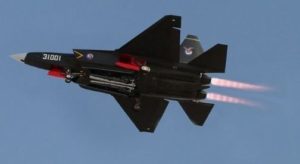
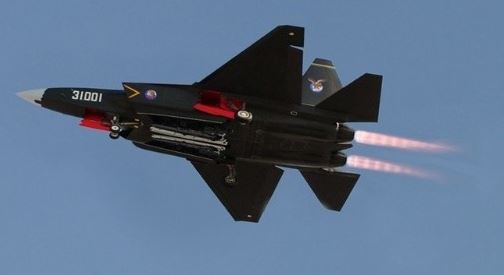
J-31 Gyrfalcon, A Supplement to China’s J-20 Against US F-22 and F-35 Fighters

The 16th Beijing International Aviation & Aerospace Exhibition was held from September 16th to 19th, and the large model of China’s J-31 “Gyrfalcon” stealth fighter was displayed, which is a fifth Generation Multi-Purpose Medium Fighter aiming at international market, a stealth fighter of the same generation as US F-22 and F-35 fighters.

According to information revealed on the expo, aerodynamic performance and stealth performance of Chinese J-31 (FC-31) stealth fighter exceed many traditional fighters, and its avionics system will also be upgraded.

Some other specification of J-31 fighter was also unveiled. The highest speed of J-31 stealth fighter is Mach 1.8, and the largest combat radius is 2000 kilometers, which meet demands for carrier-based aircrafts.

Besides, J-31 stealth fighters owns absolutely independent intellectual property, excellent composite combat performance, single-seat double-engine, twin vertical fin and flying tail, large S-type bending air inlets on two sides, and interior weapon cabins.

Chinese J-31 fighter

Like US F-22 and F-35 fighters, China’s J-31 stealth fighter also features high viability, low radar detectability and low infrared radiation, as well as outstanding electronic countermeasures and low vulnerability design. J-31 also has powerful target detecting capability and outer information composite ability, excellent situation awareness, information sharing ability, multi targets BVR attack, arge off-boresight launching all-round air combat ability, air-to-land and air-to-sea precise attack ability.

With multiple mature technologies, J-31 stealth fighter is expected to be launched for international market in five years, and become a mature and cheap fifth generation fighter by 2024, and thus replace JF-17 block 2 as an exporting fighter jet of China.

J-31’s developer AVIC also revealed that J-31 fighter will be very cheap, might be cheaper than the fourth generation fighters of the west, bad news for western countries.

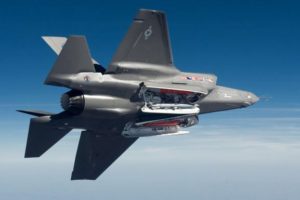
US F-35 fighter

German media reported that J-31 plagiarizes a lot of technologies of F-35 fighter, but Russian expert thinks J-31 is not a copycat of F-35.

J-31 fighter is now using Russian RD-93 engine, which will be replaced by homemade WS-13 upgrade version, and will have variants including carrier-based aircraft and fighter bomber.

In face of F-22 and F-35 stealth fighters of USA, China’s J-31 might enter service in 2020, and another stealth fighter of China J-20 owns long-range attach ability and can reach West Pacific. J-31 will be a supplement to J-20 fighter.

American officials think if China’s training, fighter amount, radar reliability and other airborne devices keep making progress, J-31 stealth fighter will soon exceed American main fighters – F-15 and F/A-18, and thus become a super weapon of China.

Spain Willing To Arm Its MQ-9 Reaper Drones, Buying From USA

Spain has confirmed that it will eventually try to weaponise its future fleet of General Atomics Aeronautical Systems MQ-9 Reaper unmanned air vehicles, although the immediate priority is to bring the surveillance-only variant into operation.

Madrid's programme to acquire a class III UAV for its air force began in September last year, with the Reaper eventually selected in mid-2015 over the competing Israel Aerospace Industries Heron TP.

“The LOA [letter of agreement] from the US government is about to be signed, and this could be done before the end of the year,” Col Enrique Martinez Vallas, former chief of acquisitions programmes for the Spanish Air Staff, told a London conference on 19 November.

Vallas says there are no technical obstacles to adding offensive capability to the Reaper as it already has hardpoints for the carriage of weapons, but the US government would have to authorise any request for weaponisation.

That has become enabled following the easing of export restrictions in February, with Italy in November becoming the first nation - outside of the UK - to receive permission to arm its MQ-9 fleet.

Spain could follow suit, but Vallas notes that it took some ten years for Italy to be permitted to arm its Reapers. Madrid, he says, is more concerned with completing the basic acquisition for now.

US Air Force

Vallas says that although both the Heron TP and the Reaper met the air force's requirements, commonality with NATO allies was a key reason for the selection of the US-built platform.

Four aircraft and two ground control stations are due to be delivered under the proposed deal, and training will begin in 2016, Vallas says.

The first two aircraft plus one ground control station (GCS) will be delivered in 2017. Initial operational capability will be achieved with the second delivery, which is expected in 2018, while full operational capability and the final aircraft are expected in 2020.

However, this schedule may be advanced if the Spanish can secure earlier production slots. Although the Royal Netherlands Air Force is seeking to acquire a similar number of systems, its acquisition has been held up over funding issues.

The Spanish air force is also in the process of acquiring an upgraded variant of the Airbus Defence & Space Atlante UAV that will be able to carry a multi-sensor and weapons payload.

The contract may be signed this year or soon after the next cabinet is formed following a general election on 20 December. “It has more capabilities with automatic take-off and landing, increased endurance and payload,” Vallas says.

USAF Denies To Acquire More Fourth Generation Fighters

The US Air Force has denied any plans to purchase another tranche of Lockheed Martin F-16 or Boeing F-15 combat jets following reports it could seek bids for up to 72 new aircraft.

According to comments attributed to a senior US Air Combat Command official at an international fighter conference in London last week, the current Lockheed F-35 procurement plan could prove unaffordable, and another fighter wing of F-15s, F-16s or perhaps even F/A-18s is being considered to supplement the current fleet – which will serve into the 2040s as F-35s are delivered.
The air force is seeking 1,763 F-35As through 2038, and in the interim it intends to modernise and upgrade its F-16s and F-15s with new active electronically scanned array (AESA) radars and electronic warfare systems.

Asked to categorically confirm or deny any new fighter purchase, a spokesman for the service’s acquisition office says: “At this time the air force has no plans to acquire 72 new F-15s or F-16s, although the air force is always looking at options to be prepared for a dynamic global security environment.”

In his final press engagement at the Pentagon on 24 November, outgoing air force acquisition chief Bill LaPlante was dismissive of suggestions that another F-15 or F-16 fighter wing is being sought, but he agrees that the F-35 is difficult to afford.

“That story was news to me,” he quipped. “We’re always struggling to get the production rate as high as we can get it on F-35. That’s as true as saying it’s cold outside. It’s always true.”

The conventional take-off and landing A-model costs just shy of $100 million per aircraft, but LaPlante says the F-35 joint programme office and the Lockheed industry team are trying to reduce that to $85 million as the manufacturing process matures.
The service stopped acquiring fourth-generation F-16s and F-15s many years ago to instead focus on developing and procuring stealthy F-22s and F-35s, but both acquisitions were far more expensive and lengthy than originally planned.

The opportunity to purchase more legacy jets, which have been kept in production through foreign military sales, is closing fast, with the Lockheed F-16 and Boeing F-15 and F/A-18 assembly lines potentially closing before the turn of the decade if no more domestic or foreign orders materialise.

The air force has budgeted for 44 F-35s in fiscal year 2016 and 48 in 2017, and is building toward a production cadence of 60 jets per year by 2018 and then 80 beyond 2020.

Friday, November 20, 2015

China Buys 24 Su-35 Flanker-Es From Russia

China has signed a contract to buy 24 Sukhoi Su-35 multipurpose fighter jets from Russia, becoming the first foreign buyer of the advanced warplane, according to manufacturer Rostec. The deal, estimated to be worth $2 billion, is a significant boost to Russia’s arms exports.

“The long negotiation on the Su-35 sale to China has been completed. We have signed a contract,” Sergey Chemezov, the head of the Russian state-owned high-tech giant Rostec, told Kommersant business daily.

Chemezov didn’t disclose the details of the deal, but Kommersant cited sources in the Russian arms industry as saying that China had purchased 24 Su-35s at a price of about $83 million each.

The Su-35 (designated Flanker-E+, not to be confused with the Su-27M, which used to be called the same name before its discontinuation) is a long-range “4++ generation” fighter jet. It is armed with an internal 30mm cannon and has 12 hardpoints with a combined capacity of 8,000 kg, compatible with a wide range of unguided and guided missiles and bombs.

The Russian armed forces are the primary operator of the aircraft, with 36 series Su-35s currently in their possession and more to be produced. China first showed its interest in buying Su-35s in 2008 during the Airshow China international expo. Formal negotiations started in 2011.

According to Kommersant, the deal does not involve domestic production of Su-35s in China, a condition usually desired by Beijing due to its strategic goal of producing an entire range of the weapons it uses on its own territory.

The deal would ensure Chinese Air Force superiority in the region amid brewing conflicts with other nations, such as the Philippines and Japan, over territorial disputes. China’s own production capabilities of advanced warplanes, including the J-11, are not yet sufficient to maintain the necessary strength, according to Chinese media.

China is currently among the world’s top five buyers of Russian arms, restoring its position after a slowdown in late 2000s. Beijing buys advanced Russian jet engines, submarines and surface-to-air missiles, among other high-tech military items.

Source: RT News

The Kuwait Air Force (KAF) Inventory And Air Power

The Kuwait Air Force (القوات الجوية الكويتية) al-Quwwat al-Jawwiya al-Kuwaitiya), was formed in 1961 while in late 1960s twelve Strikemaster Mk.83s, Lightning F53s and two T55 trainer versions  were delivered.

Subsequently in 1971, two Lockheed L-100-20 Hercules subsequently  between 1968 and 1977 two Bell 206, eight Agusta Bell 205s entered the service.

In 1974. a total of 27 Mirage F1CKs and seven Mirage F1BKs were ordered and delivered in two separate batches until 1983.

Thirty six (36) Douglas (T) A-4KU Skyhawks that were ordered in 1974 and delivered during 1977.

During he same period, twenty four (24) SNIAS SA342K Gazelles were delivered, four were later transferred to the Kuwait Police Air Wing.  Four L-100-30 Hercules transport aircraft were delivered in 1983, replacing the shorter L-100-20 version from which only one survived (the other crashed in France). Also in 1983, twelve Hawk T64 were ordered to fulfill the requirement  for training capacity.

The Shorts Tucano T.52, was scheduled for delivery 1990 but was deferred to 1995 due to the Kuwait's occupation.

After the the liberating Kuwait from Saddams’s forces, the KAF underwent reorganization and both the Douglas A-4 Skyhwaks and the Dassault Mirage F1s were phased out in favour of the McDonnell Douglas F-18 Hornet. 32 F/A-18Cs and eight F/A-18D Hornets. The Mirages have been  withdrawn from service and placed in storage.

The first six of sixteen ordered AH-64D Apache Longbow attack helicopters were delivered to the Kuwait Air Force on 3 February 2006. The remaining ten aircraft were delivered thereafter. All the helicopters are preconfigured to carry the AN/APG-78 Longbow radar kits.

The air force is capable of performing a range of missions.  Has enhanced the ability to react rapidly and provide anti-armour support to land forces.

Commander of the Air Force: Vice Marshall Yusef al-Otaibi

Air Force Personnel Strength: 2,500

Inventory Summary:
Combat: 58 (total),  39 (in service)
Transport: 5 (total), 5 (in service)
Helicopters: 48 (total), 39 (in service

Source: IHS Jane's
Photos: Google Earth & ArabAviation

Wednesday, March 12, 2014

Assessing PLA Underground Air Basing Capability

The PLA's network of around forty underground airbases provides a unique and indeed superlative capability to withstand a large scale counter-air campaign, as significant effort with penetrating munitions of large mass would be required to close such bases down for the duration of the campaign, or permanently render them unusable.
 
China's Underground Airbases, Geographical Placement (red - PLAAF, blue - PLANAF, green - unidentified tenant afiliation)

As these bases deny surveillance by orbital, airborne or ground based ISR assets, they provide an inherent capability to perform covert preparations for combat operations, be it in times of conflict, or in the period immediately preceding a conflict.

The hangaring capacity of these underground bases is of the order of at least 1,500 combat aircraft, possibly greater, if more than basic internal tunnel arrangements have been employed. This capacity represents more than the total number of modern combat aircraft currently operated by the PLA.

In strategic terms, the PLA's underground airbase infrastructure provides a capability to deny at this time even the United States the opportunity to inflict massive early attrition upon the PLA's fleet of combat aircraft, while these are on the ground. This would force any opponent, including the United States, into a protracted aerial war of attrition, before decisive losses could be inflicted upon the PLA combat aircraft fleet.

The inherent survivability of the PLA's impressive underground airbase infrastructure has not been a major consideration in the ongoing debate in the United States on the utility, and indeed intended design, of the replacement heavy bomber aircraft. If the defeat of the PLA's underground airbase infrastructure is part of the intended role of this future aircraft, then this aircraft will need to combine the survivability needed to repeatedly penetrate what is becoming the most capable Integrated Air Defence System in existence, with the ability to deliver heavy “earthquake bombs”. Anything less will result in unsustainable combat attrition.