Showing posts with label Terrorism. Show all posts

Friday, May 20, 2016

ISIS Vehicles Being Hunted By Russian Mi-28 Helicopters In Eastern Homs, Syria

SHARE on FB, Twitter, Instagram, G+ - ISIS Vehicles Being Hunted By Russian Mi-28 Helicopters In Eastern Homs

Subscribe to Military Tiger - MilitaryTiger

After Russian President Vladimir Putin decided to assist his friend in Syria, President Bashar al-assad, the scenario of the Syrian Civil War changed. By sending Russian Air Force and then Russian Special Operations Forces to Syrian soil to fight deadly terrorism of ISIS/Daesh it changes the faces of the war forever. Russian Air Force's continuous bombing on ISIS positions created devastating situations and forced those inhumane terrorists to pull back! Putin's intervention into Syrian war significantly reduced Daesh's mass killing of innocent civilians across Syria and Iraqi territories this terrorist group captured.


Firslty Russians cleared forward areas those were in ISIS capture and then compelled them to pull back. While Syrian Arab Army holds some ground Russia intensified the air strikes which created havocs for ISIS! They broke the supply chain of ISIS, curtail arms supply and finally made them to gather in holes that Russian fighter jets and Spec Ops Force Spetsnaz along with SyAA can smash these terrorists group forever.

However, most of the western leaders and mainstream media made, and still, crocodiles' tears by shouting that Russians targeting innocent civilians who're not supporting Bashar al-Assad. Kremlin didn't hear it but, proved it that CIA-Mossad-Saudi nexus created and keep alive ISIS and oither Syrian terrorists groups to topple Assad. In fact, Turkey was dealing it with great eagerness to see Assad ousted and handling the whole matter from behind the curtain.

Although, whose are behind ISIS, it's now smashed to death! Definitely credits goes to Putin's Russia! Toppling plan for Assad is now dead but very recently Saudi Foreign Minister al-Jubeir said that Plan-B to oust Assad will be implemented! To whom he threw the threat, we all know! We must wait and see what happens next!

                                             ♥ Follow us on ♥

                           https://www.facebook.com/MilitaryTiger
                           https://www.twitter.com/Military_Tiger
                           https://www.instagram.com/military_tiger
                           https://www.pinterest.com/militarytiger/
                           https://www.google.com/+MilitaryTiger

                          
                                   ○○○ Stay Tuned and Enjoy ○○○

Wednesday, January 13, 2016

UK Used Brimstone Missiles First Time In Syria

Royal Air Force used Brimstone missiles for the first time in Syria to strike against Daesh. Four attck was carried out by RAF combat jets deployed in the Middle East to fight against Daesh/ISIS/ISIL. Two of the strikes near Raqqa, targeted a vehicle and in the Omar oilfield in the eastern Syria, media reports. Two Tornado jets used a Brimstone missile to destroy a supply truck near Raqqa, and Paveway IV laser-guided bombs to target two IS buildings, including a command and control center. Another two Tornados and a Reaper drone used three Brimstones, as well as Hellfire missiles, to attack a number of mobile cranes brought in by IS to the Omar oilfield to try to repair damage inflicted by previous air strikes.
An MBDA Brimstone II missile 
Brimstone missiles are radar-guided and can be used against moving targets. The RAF has carried out several strikes in Syria since MPs voted in favour of extending UK action into the country on 2 December. The UK and Saudi Arabia are the only two countries to have purchased Brimstones.

Monday, December 7, 2015

Deadly Air Strike Hits Syrian Forces, For Troops Killed

An air strike has killed four Syrian military personnel in Deir al-Zor province, news reports said on Monday.

The Syrian Observatory for Human Rights said the strike hit part of the Saeqa military camp near the town of Ayyash in Deir al Zor province. 

The air raid wounded 13 Syrian military personnel.

A source close to the Syrian government confirmed the strike to the Reuters news agency and said there had been casualties and vehicles destroyed.

The strike hit some time in the last 24 hours, the monitoring group said.

It was not immediately clear which air force was responsible. The area is largely under the control of the Islamic State of Iraq and the Levant (ISIL).

A US-led coalition has regularly targeted the group in the Syrian province.

Russia also began launching air strikes in Syria in September. 

In Deir al-Zor city, another air strike overnight Sunday killed a woman and two of her children, the Observatory said.

Friday, December 4, 2015

Russia Reinforcing its Military Presence in Central Syria Near Palmyra

Russia is reinforcing a military airport in central Syria as a new base for its warplanes as government forces edge closer to Palmyra, a military source and monitoring group said Thursday.
Russian Sukhoi Su-30 SM jet fighters land on a runway at the Hmeimim air base on Oct. 3 in the Syrian province of Latakia.
"The preparation phase for the Shaayrat base is nearing its end. It is being prepared to become a Russian military base," the military source told AFP, declining to be named.

"A number of Russian advisors arrived in Shaayrat weeks ago," the source said. The base "will begin being used by Russian forces before the end of this month."

Since Moscow began airstrikes in Syria on Sept. 30, its Su-34, Su-24, Su-30 and Su-25 planes have operated out of Hmeimim base in the coastal province of Latakia.

Shaayrat lies in Syria's central Homs province, north of several towns where government forces and allied militia backed by Russian airstrikes have been fighting the Islamic State jihadist group.

Late last month, regime forces recaptured the town of Maheen after IS had overrun it on Nov. 1.

Government troops have fought to edge closer to the historic town of Palmyra, about 130 km (80 miles) east of Shaayrat and held by IS since May.

Rami Abdel Rahman, head of the Syrian Observatory for Human Rights, said Russia was "building new runways at the Shaayrat airport and reinforcing its surroundings in order to use it soon for operations" in Homs province.

Abdel Rahman said Russian helicopters were already using the nearby T-4 military airport to strike IS targets in Palmyra.

"Syrian regime forces are about three kilometers (less than two miles) from Palmyra and are advancing from the south and west with air cover by Russian helicopters," he said.

The troops have also reached the edges of Al-Qaryatain, a mixed Christian-Muslim village in Homs province that IS seized in August.

The military source said Russian and Syrian aircraft had conducted at least 40 strikes in and around Al-Qaryatain in the past 24 hours.

He said there would be "an important advance" within 72 hours.

Russian President Vladimir Putin pledged to intensify his country's fight against IS after the organisation's Egypt affiliate claimed to have shot down a Russian airliner carrying 224 passengers.

Starting on Oct. 7, Syria's army launched ground attacks with Russian air support in at least four provinces across the country.

The army has also advanced in parts of Aleppo province of northern Syria.

Tuesday, November 17, 2015

Pakistan, China To Cooperate In Space as Part of Karamay Declaration

The Chinese government has agreed to a proposal by the Federal Minister for Planning and Development Ahsan Iqbal, initiating the collaboration between Pakistan and China in space technology as part of the Karamay declaration under China-Pakistan Economic Corridor (CPEC).
At the Pakistan-China forum meeting held in Karamay-Xinjiang last week, Ahsan Iqbal, proposed space technology collaboration between China and Pakistan, an official of the forum told APP.

His proposal was approved and made a part of the Karamay-Xinjiang Declaration. The declaration was later approved unanimously after the two-day meeting.

At the concluding session, Ahsan Iqbal said that bilateral collaboration on space technology would take Pakistan-China relations to new heights. He stressed upon a joint launch of space missions which would consist of astronauts from both countries.

He said “CPEC will increase connectivity between the two friendly countries. It will shape up the future destiny of both the nations through communication linkages”.

Chinese Ambassador to Pakistan, Sun Weidong, was also a part of the CPEC forum. He labelled the meetings as successful in increasing understanding among the related stakeholders for implementing CPEC. He also pointed out the field of energy and communication as a major part of the CPEC.

Over 300 officials, businesspersons and public figures were a part of the two-day forum.

Another decision made at the forum was to make these meetings a permanent platform that will meet every year to examine the project and present collaboration on broader aspects. The forum will also be used to ensure the project's true objective of promoting Pakistan-China relations.

Saturday, October 24, 2015

Pakistan Army Again Used Burraq UCAV At Night-Time Attack

A press report from Pakistan Armed Forces Spokesman (ISPR) stated that PA used Burraq drone to target TTP terrorists at night-time attack last thursday. This official source also said the attack was highly precise and targeted terrorists were eliminated. But the numbers of terrorists were terminated is not specified by any independent source. Burraq drone  uses the newly developed "Burq" air-to-surface missile.

Pakistan became one of the fifth country that build and deployed "home made combat drones" in an active war scenario all over the world. Previously they used this combat drone first time after its successful tests to target TTP terrorists in the Shawal Valley war front and successfully killed 4 TTP terrorists among two high level commanders.

Wednesday, May 27, 2015

Pakistan's Stronger Ties With Central Asia Will Change This Area's Military, Economic & Security Scenario As Well

Pakistan's Prime Minister Nawaz Sharif concluded a visit to the Central Asian region on 22 May Friday, pushing to expand energy, security and tourism ties with the former Soviet states, essentially to sign deals to overcome Pakistan's chronic power shortages.
 
Pakistan Prime Minister Mr. Nawaz Sharif.
In a meeting with his Kyrgyz counterpart, Temir Sariyev, in the capital Bishkek, Sharif discussed an electricity project that would see Pakistan import up to 1,000 megawatts from mountainous Kyrgyzstan and Tajikistan. Sharif also met Kyrgyz President Almazbek Atambayev during the visit. Sharif flew to Bishkek from the Turkmen capital Ashgabat, where he spoke with Turkmenistan's leader Gurbanguly Berdymukhamedov.

The 1,200-kilometre (750-mile) power line, which would also supply 300 megawatts to conflict-torn Afghanistan, "would ease the electro-energy deficit" of his country of 185 million people, Sharif said as the two agreed to develop energy, security and tourism ties. Sariyev promised his country's "active participation" in the project, known as CASA 1000.

Though the World Bank is financing half the project, CASA 1000 faces challenges since Kyrgyzstan and Tajikistan can produce an energy surplus only in the summer when their mountain rivers fill with water. The project would therefore only partially solve Pakistan's politically contentious deficit.

Little detail was disclosed from negotiations in secluded gas-rich Turkmenistan, but they were likely focused mainly on TAPI, the ambitious pipeline project valued at up to $10 billion that would pump Turkmen gas to the South Asian country and India, also via Afghanistan. The planned 1,800-kilometre link could deliver 33 billion cubic metres (bcm) of gas annually to the growing Indian and Pakistani markets with Afghanistan likely to absorb no more than 0.5 bcm.

After the talks, Sharif said that he hoped to intensify work on the TAPI project that would bring advantages to the entire region. The pipeline however faces security concerns in Afghanistan and ballooning costs while it lacks a commercial investor. Afghan President Ashraf Ghani said in April the project may take five years to complete.

Earlier, Pakistan and the Central Asian republics have signed several memoranda of understanding on economic cooperation and collaboration in various fields. An inter-governmental Joint Economic Commission has also been set up with the countries in the region to give impetus to trade, economic and scientific cooperation. But the expected economic growth has not materialized mainly because of lack of implementation of the agreements. Pakistan and Central Asian states are members of ECO, whose main objectives include developing and improving the economic infrastructure and transportation system in the region. However, the organization has lost its effectiveness and has been eclipsed by the emerging SCO, which has in its folds two major powers, Russia and China.

Historically, the areas that make up Pakistan have had close cultural and economic relations with the central Asia region. Central Asia has been closely tied to its nomadic people and the Silk Route, which has acted as a crossroads for the movement of people, goods, and ideas between Europe and Asia for centuries. British occupation of India and Russia’s control over Central Asia had disrupted these ties in the late 19th century. Soon after gaining independence from Britain in 1947, Pakistan joined the anti-communist bloc, which prevented Islamabad from developing close relations with the Central Asian region. Pakistan had no direct contact with Central Asia under Soviet rule.

Since the disintegration of the Soviet Union, the energy-rich and land-locked Central Asian Republics (CARs) have assumed great significance in Pakistan’s foreign policy considerations. Pakistan’s geographical proximity with the Central Asian region, the geo-political and geo-economic significance of the CARs and the desire to become the gateway to Central Asia have stimulated Islamabad’s interest in building closer political and economic ties with the region, which includes five republics of the former Soviet Union: Kazakhstan, Kyrgyzstan, Tajikistan, Turkmenistan, and Uzbekistan.

Pakistan renounced its pro-Taliban policy after 9/11 and the shift in Pakistan’s foreign policy since then has enhanced Islamabad’s cooperation and economic links with Central Asia. However, the nature of Pakistan’s relations with former Soviet Central Asia has largely been economic rather than political or strategic.

Pakistan has long portrayed itself as a natural trade route for Central Asian republics to reach world markets by availing transit facilities and access to Pakistani seaports. Several agreements have been signed to develop the communication links, including road and rail links. However, lawlessness and instability along all these routes have proven to be a major hurdle in realizing the potential for economic cooperation. The CARs have encountered a litany of post-independence problems, including rapid economic and socio-political transformation, security challenges, and suppression of human rights and fundamental freedoms.

Pakistan and the CARs share many things including religion and cultural ties. However, Islamabad’s desire for close political and economic ties with the Central Asian region has been plagued by its foreign policy, mainly on Afghanistan. Pakistan’s ties with the region are nowhere near as robust as the initial warmth had indicated when these Central Asian republics gained independence after the collapse of the Soviet Union. A multitude of internal and external challenges facing the region have hampered progress in that regard. Unlike the other main players in the region, including Russia, China, India, Iran, Turkey and the US, Pakistan’s political conditions, unrest in Afghanistan and fragile economy have prevented it from engaging with Central Asia.

The Central Asian states want to expand trade ties with Pakistan and develop new infrastructure. Turkmenistan would like to boost energy sales through the construction of the TAPI pipeline, while Kazakhstan and Kyrgyzstan are growing markets for Pakistani goods. Pakistan in turn is interested in expanding its imports of Central Asian energy (hydroelectricity as well as gas). These economic ties ensure a common interest among the Central Asian states and Pakistan in having stability in and secure transit across Afghanistan. Nevertheless, Pakistan’s hopes of becoming Central Asia’s main artery to global commerce have been disappointed.7 Central Asian States’ Relations with India In the long run, the Central Asian states generally view India as an important economic partner that can help ameliorate their dependence on Russia and China.

The strategic importance of Pakistan’s Balochistan province has grown since China started building a deep sea port in Gwadar.6 Pakistan’s economic development depends on how it takes advantage of the tremendous economic and trade potential of energy-rich Central Asia. Balochistan is a vital link to expansion of economic ties and cooperation with Central Asia. But all that would depend on ensuring security and law and order in the province. Balochistan is ideally situated to cater to the energy and trading needs of other countries in the region and make Pakistan an energy hub for Asia. The Gwadar deep sea port is expected to serve as a secure storage and transhipment hub for the Middle East and Central Asian oil and gas supplies through a well-defined corridor passing through the country. In fact, if all goes as planned, Gwadar would be the terminus of multi-billion dollar gas pipelines.

India lacks a direct geographical links with Afghanistan and Central Asia. It has to pass through Pakistani territory for any access to this region. By keeping close links with Afghanistan, especially post- 9/11 and supporting the Karzai government, New Delhi has managed to expand its role in the war-torn country. Islamabad has also charged India of seeking to create unrest along Pakistan’s western borders, especially in Balochistan, and exploiting the situation.

Indian policymakers believe that any advance by Islamist militants in Central Asia could invigorate similar elements active in Indian-administered Kashmir. India has also proposed an energy pipeline from Russia across Central Asia and China. Another gas pipeline which is of significant interest to New Delhi seeks to connect India to Turkmenistan through Afghanistan and Pakistan, although progress in that regard depends on the nature of relations between New Delhi and Islamabad as well as the security situation in Afghanistan. The degree of strategic cooperation between India and the CARs is evident from the fact that New Delhi has established a military base at Farkhor in Tajikistan.

The base has been operating since May 2002 in an area close to the border with Afghanistan. This has had serious implications for Pakistan’s strategic interests in Central Asia. India also has the observer status with the Shanghai Cooperation Organization.

Both USA and Russia, as per their joint anti-Islam agenda, do not want Central Asian nations to come closer to Pakistan for religious reasons. Lack of a common border with any Central Asian state is one of the primary impediments to accessing the region. Instability in Pakistan does not help promote strong ties with CAR.

Relations between the United States and the five Central Asian countries are largely positive, notwithstanding tensions over the spotty political and human rights environment in some states. Much U.S.–Central Asian cooperation is connected to the war effort in Afghanistan, which the Central Asians are assisting with logistical support, infrastructure, and security cooperation.

As the leader of former Soviet Union of which Central Asia was also a part, Russia remains the most important security actor in Central Asia, though its economic position is being rapidly overtaken by China. Russia is seeking to limit the Central Asian states’ reorientation towards China (and, to a more limited extent, South Asia) by promoting regional re-integration through bodies like the Customs Union and CSTO. With the withdrawal of foreign forces from the region, Russia is looking to reinforce its own presence. It reached agreement with the governments of Kyrgyzstan and Tajikistan to extend the deployment of Russian forces into the middle of the century, and has sought to improve the capabilities of the CSTO to address threats to regional security, including those coming from Afghanistan. Given Russia’s large Muslim population (including millions of Central Asian migrants), Moscow regards extremism and instability in Central Asia as a direct threat to its security. Russian pressure played a role in blocking the deployment of Indian combat aircraft in Tajikistan.

Afghanistan offers the most direct access for the Central Asian region to ports and markets in South Asia and the Persian Gulf. Afghanistan can also be the conduit for Central Asian oil and gas to South Asia and Iran. But such benefits for both Pakistan as well as Central Asia could be realized only when the situation in Afghanistan is sufficiently stabilized and secure land access is possible.

The major internal dynamics affecting Central Asia’s influence and interests in South Asia are continued weak governance, including rampant corruption, the potential for state failure at least in Kyrgyzstan and Tajikistan, entrenched criminality, and mistrust and low levels of interdependence among the five states. The impact of all these problems could be exacerbated by uncertainty surrounding the succession to long-time leaders.

Moreover, much of Central Asia with abundant energy resources faces demographic shifts—growing youth populations lacking the Soviet-era education and values of their elders—coupled with shortages of water and other resources that could contribute to civil strife or crossborder conflict. To the extent these internal dynamics contribute to instability within Central Asia, governments in the region are likely to place a greater emphasis on preventing the spread of drugs, crime, and other problems from South Asia. Imbibing truly Islamic values can save the region, making it a strong economic union.

South Asia is likely to remain a niche partner for Central Asia, especially for states looking to reduce their dependence on Russia and China for access to global markets. Cross-border violence in South Asia would make even this limited degree of integration problematic.

An Indo-Pakistani conflict over Jammu Kashmir which both South Asian nuclear powers share in occupation would undermine—likely for good—USbacked plans for Central-South Asian economic integration, making it impossible to build infrastructure across Pakistan to markets in India. Central Asia would then look even more to alternative outlets, including Russia, China, and perhaps Iran.

The biggest threats to Central Asian stability, however, are indigenous to the region: poor governance, state failure, demographic change, criminality, and rising extremist tides. And this factor binds CAR with a corrupt and destabilized Pakistan.

Security cooperation between the Central Asian states and Pakistan has improved in recent years, but many Central Asians remain wary of Pakistan’s double game with Islamist militants and support for non-violent Islamist groups such as Tablighi Jamaat that are banned in Central Asia. The Central Asian states’ generally positive relations with India also limit prospects for cooperation with Pakistan as long as Indo-Pakistani ties remain poor. Tajikistan allowed India to launch its military bases on its soil in return for money and more business.

The Central Asian states want to expand trade ties with Pakistan and develop new infrastructure. Turkmenistan would like to boost energy sales through the construction of the TAPI pipeline, while Kazakhstan and Kyrgyzstan are growing markets for Pakistani goods. Pakistan in turn is interested in expanding its imports of Central Asian energy (hydroelectricity as well as gas). These economic ties ensure a common interest among the Central Asian states and Pakistan in having stability in and secure transit across Afghanistan. Nevertheless, Pakistan’s hopes of becoming Central Asia’s main artery to global commerce have been disappointed.7 Central Asian States’ Relations with India In the long run, the Central Asian states generally view India as an important economic partner that can help ameliorate their dependence on Russia and China.

Establishment of peace in Afghanistan is of utmost importance in order to maximize economic prospects for both Pakistan and the CARs. Pakistan’s policymakers now have to formulate a comprehensive policy on the Central Asian republics in order to turn constraints into opportunities. Pakistan must develop good diplomatic ties with these states as well as develop economic ties with them by facilitating them with regard to trade and pipeline routes. This can only be done if Pakistan improves its economic, security and political conditions. Pakistan can boost ties with Central Asia by undertaking both individual and joint ventures in all economic fields.

Despite all impediments, the economic and cultural ties between Pakistan and Central Asian nations would, in the years to come, grow further.

 
By Dr. Abdul Ruff - Asian Tribune -

Saturday, April 11, 2015

Why The Holy Places Like "Mosques" Are Targeted?


Why those hellish demons are targeting the holy places, whatever its a Mosque or Tomb/Temple of other religion! Al-Qaeda gone, anti-Bashar elements failed! Now man eater demons are organized behind the form of ISIS, humiliating the religion. Would this bring any scenario in front of world people? Yes! Some analysts and critics showed evidences that ISIS is formed and propagated by the CIA-Mossad joint venture by the full fledged fueling by the Saudi King family! May be its true or not, question is that "why they (world powers) can't stop!

See the brutality below:


Tuesday, April 7, 2015

Questions Which Tangled The Concerns Over Saudi's Proposal To Pakistan For Joining In Yemen Attack


1: Currently FATA, LOC, Indian border, Afghanistan border, Karachi, Siachen & Khuzdar are active fronts which have stretched Pakistan military's capabilities, leading for them to make immense changes in conventional force posture. If the Parliament does approve the deployment of Pakistan Army into either Saudi Arabia or Yemen, it would leave Pakistan Army even more stretched with its resources and manpower. If Pakistan is going to fulfill a capability gap for the Saudi military forces, who will fulfill the gap left by the deployment of Pakistan Army inside Pakistan's own low intensity conflict zones?

Outcome of Saudi Invasion on Yemen: 


2: Would Saudi Arabia and its allies be willing to make a token military contribution to Pakistan's conventional defenses should another war with India breakout?

3: What guarantee there is that India won't take advantage of the Pakistani deployment to the Middle East by being assertive on the border or by teaming up with Iran and Afghanistan to isolate Pakistan as it has always wanted to?

4: What contingency plan does the govt have if such a deployment fuels further sectarianism in Pakistan?

5: What would the govt do if Iran who would be unhappy about such a deployment reactivates its own proxies inside Pakistan to create a situation right here in order to make Pakistan 'pay' for it?

Two non-democratic power grabber. 
6: Why would the govt not specify, in the light of Pakistani national interests what exactly are the objectives for which they want to join this coalition?

7: Why Al-Qaeda in Arabian Peninsula and Daesh haven't yet been targeted in Yemen by the coalition airstrikes?

Tuesday, February 24, 2015

The Drama Was Staged, What Comes After?

Pakistani boat controversy was a drama: FO

 
Foreign Office (FO) spokeswoman Tasneem Aslam said Friday that Pakistan had had made it clear that none if its boats went missing as claimed by Indian officials.
"It has been proven from the contradictory statements issued by top Indian officials that the boat issue was a drama that has now been exposed," said Aslam.

Earlier on Wednesday, India's Deputy Inspector General of the Coast Guard denied reports which said that he had admitted ordering for a Pakistani boat to be blown up in the Arabian Sea on New Year's eve. 


The claim was in sharp contrast to New Delhi's official position which had been adamant that the boat had 'suspected terror links' and that the crew had committed suicide by setting the vessel on fire. 

Coast Guard DIG B.K. Loshali later issued a rejoinder which rejected the media report terming it as 'not factual' and denied making any such claim.

Pakistan only executing hardened terrorists

Furthermore, Aslam rejected the European Union's human rights concerns over death sentences and made it clear that Pakistan was executing only those criminals who had been convicted in terrorism cases. 

"The executions are not a violation of any international law," remarked Aslam.

She expressed ignorance when asked as to whether the EU had sought access to proceedings at the military courts in Pakistan and said that these courts came into being by an Act of Parliament.


Sunday, February 8, 2015

RAW Plans Leaked, claim tweeps in Pakistan

#RAWPlansLeaked, a conspiracy theory that has been making rounds for some time now, has heated up emotions on social media as well, as the Pakistani tweeps trended the hashtag and blamed India of being involved in terrorist activities against Pakistan and throughout the region.

The Memo of Attack Civilians inside Indian held Kashmir, an evilous order from RAW director (Ops).

A document, allegedly from Indian intelligence agency RAW, is being claimed to have been leaked by some insider on the internet. This document says that the aforementioned Indian agency has planned to attack some target in Baramula city of the Indian Held Kashmir. The words ‘Dress Mujahideen’ in the first point, first paragraph, seem to be hinting that allegedlythe plan was to blame it on the Islamist militants.

Tweeps alleged that the India was planning an attack in Indian Held Kashmir on the lines of Mumbai attacks, carried out on November 26, 2008.

Saturday, January 10, 2015

Lance Naik Imran Khan: A Hero of #PeshawarAttack

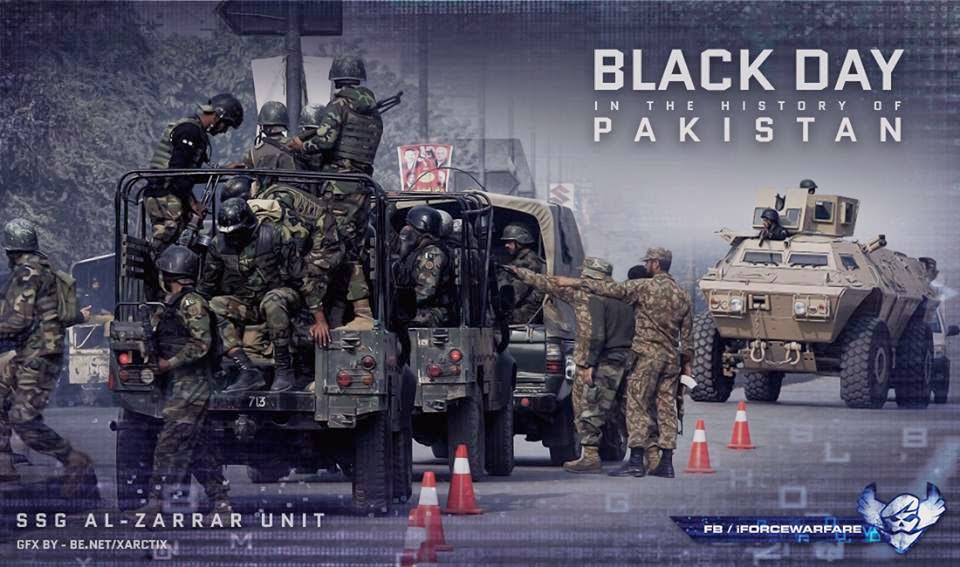
Meet legendary unsung hero of this nation. Meet Lance Naik Imran Khan. He joined Pakistan army in 2003 and was allotted artillery corps but from the start he wanted to join Special services group (SSG). After 2 years of service he got enrolled in Zarar company of SSG Its been 10 years he is in SSG, During all this time he never hesitated and was always there on duty. He took part in Dera bughti operation, Manawa Rescue, GHQ Rescue and lastly Peshawar rescue mission.
 
Lance Naik Imran Khan, the hero who will not be forgotten.
As per his remarks Peshawar rescue mission was the toughest experience of his life. It was a close combat and there were no hostages due to which they didnt have any time to plan out things. Despite all hardships he and his team fought with bravery and valor.

"khoon mei bachu ko dekh kar meine azam kiya ya woh rahen gay ya mein . Alhumdullilah Allah ne aik ankh ki qurbani qabool ki aur Allah ka karam hai hum ne sub ko wahin khatam kr dala "

During this rescue mission he got badly injured. He sacrificed one eye but he was proud and content with his service for the nation.

"When i got hit on my eye i fell down and i asked my comrades to repeat after me i started reciting Kalma and Alhumdulillah i was reciting Kalma when i got fainted ".
 
Source: Pakistan defence

Wednesday, December 17, 2014

Who Says These Are Human!?

Pakistan Army should intervene inside Afghanistan to kill all those terrorists.

Blood of angels.
This is they do, pray to Almighty.
 
Blood of angels

Evacuating
 

Blood of angels
Blood of angels
  
A maggot

Add caption


Angels