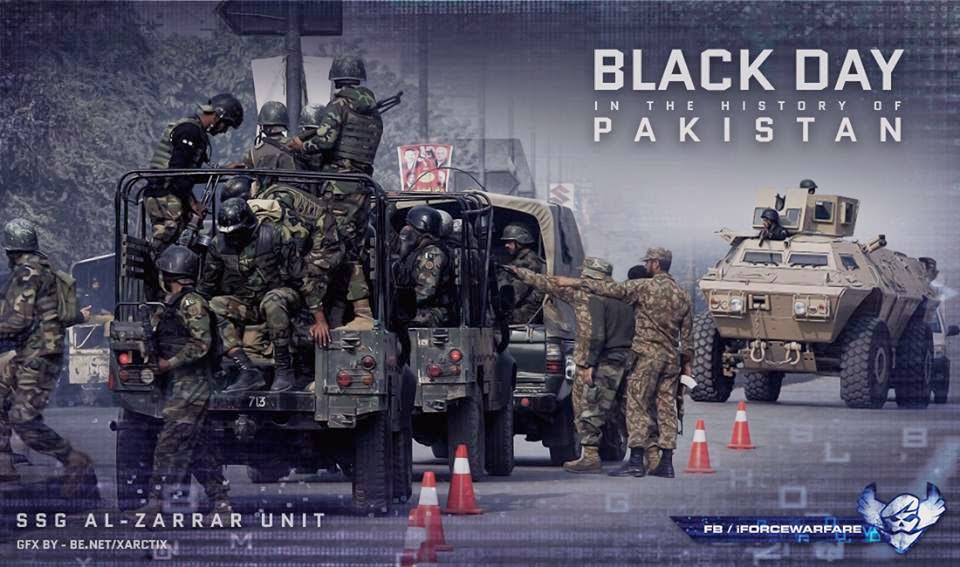
Without an appropriate military power, a small state is on the mercy of neighboring big states; which senses its sovereignty is under threat..........
Wednesday, December 17, 2014
Who Says These Are Human!?
Labels:
Afghanistan,
India,
Mollah Fazlu,
Operation Zarb-e-Azb,
PAF,
Pakistan,
Pakistan Army,
Pakistans' War Against Indian Terrorism,
Peshawar Attack,
Son-of-Bitch Fazlu,
SSGs,
Terrorism,
TTP
Hand Over Fazlullah: Army Chief Set To Tell Kabul
General Raheel is traveling to the Afghan capital after security agencies found evidence that the Peshawar attack, which killed 141 people, including 132 children, was planned inside Afghanistan by the Mullah Fazlullah group.
The army chief is accompanied by DG ISI and will meet his Afghan counterpart and Afghan President Ashraf Ghani, as well as the ISAF commander to present evidence of the Peshawar massacre’s linkage with TTP sanctuaries in Kunar and Nuristan province.
DG ISPR Asim Bajwa tweeting details of the visit said the army chief will return to Peshawar after his visit to Kabul.
A security source told The Express Tribune that Pakistan would want immediate action against TTP hideouts.
“If Afghan authorities fail to act this time, we will explore all options, including hot pursuit,” cautioned the source.
Another official, however, hoped that unlike the Karzai administration, the current government in Afghanistan would stop supporting anti-Pakistan elements.
The official disclosed that General Raheel, during his talks in Kabul today, would seek the extradition of Mullah Fazlluah, whose group claimed responsibility of the dastardly attack on Tuesday.
Source: tribune.com.pk
Labels:
Afghanistan,
COAS,
DG ISI,
DG ISPR Asim Bajwa,
ISAF,
Mollah Fazlullah,
Operation Zarb-e-Azb,
Pakistan,
Pakistan Army,
Pakistans' War Against Indian Terrorism,
Peshawar Attack,
Terrorism,
TTP
Sunday, December 14, 2014
Saturday, December 13, 2014
Australia-India Uranium Deal Under Scrutiny For 'Lack of Safeguards'
Australia's uranium deal with India is under scrutiny following the warning of a former chief atomic watchdog that the treaty did not have all the safeguards necessary to prevent India from fuelling its nuclear bombs.
The treaties committee of Parliament was urged to endorse the deal signed by Australian Prime Minister Tony Abbott in September before exports of uranium can begin, The Age reported. However, John Carlson, former head of Australia's nuclear safeguards organisation, told the parliament committee that the nuclear weapons programme of India is expanding with complex links to non-government reactors.
Labels:
Australia,
Defence,
Indian Nukes,
Military,
Nuclear,
Nuclearweapon,
nukes,
Pakistan,
South Asia,
South Asian Defense Factors
Wednesday, December 10, 2014
Bangladesh Orders Two AW139 Helicopters for Maritime SAR
AgustaWestland announced that the Ministry of Defence (MoD) of the People’s Republic of Bangladesh has signed a contract for two AW139 intermediate twin-engine helicopters.
These helicopters, which will be delivered by the end of 2015, will be operated by the Bangladesh Air Force to perform maritime search and rescue (SAR) and other utility missions.
This contract, which also includes a comprehensive support and training package, marks the establishment of the first dedicated maritime SAR helicopter fleet in the country. The AW139 was selected after an extensive evaluation process against a wide range of requirements including performance and safety.
Labels:
AgustaWestland,
AW139 SAR Helicopters,
BAF,
Bangladesh,
Bangladesh Air Force,
BN,
Maritime SAR
Former Chinese General Says Force An Option in 'Taiwan Problem'
BEIJING — An army general has warned that China will not leave the Taiwan problem “unresolved for a long time,” after the island’s Beijing-friendly ruling party suffered a bruising election defeat, a state-run newspaper said.
![]() |
Taipei, Taiwan. (Getty Images). |
Liu Jingsong told the annual conference of the Global Times newspaper that the Chinese government would not be afraid to use force to resolve “the Taiwan issue,” the Chinese-language paper reported Saturday on its website without specifying further.
“The Taiwan issue will not remain unresolved for a long time. We will not abandon the possibility of using force; according to the law, it is also an option to resolve the issue by military means if necessary,” said Liu, a former president of the influential Chinese Academy of Military Sciences.
He retired from active service with the People’s Liberation Army in 1997.
“Whoever has political power in Taiwan, the only path (for the island) is to preserve the development of peaceful relations between the two sides of the strait, and eventually to bring about reunification,” the general said.
Taiwan and China split in 1949 at the end of a civil war, but Beijing still claims the island as part of its territory awaiting reunification — by force if necessary.
Taiwan’s ruling Kuomintang (KMT) was dealt a crushing blow in local polls in late November when it lost five out of six large municipalities on the island, prompting Premier Jiang Yi-huah to resign and President Ma Ying-jeou to step down as KMT chairman.
The KMT’s move to forge warmer ties with Beijing, and its perceived secrecy in forging deals with the mainland, was one of the core issues at stake in polls seen as foreshadowing the 2016 presidential race.
In face of the recent shakeup in Taiwan’s political landscape, China “should not fear the storm” and has formed “new judgments and countermeasures,” the Global Times paraphrased Liu as saying.
In March and April this year Taiwanese students staged a mass three-week sit-in in the parliament building in Taipei in protest at a proposed trade pact with the mainland.
Tense relations with China have warmed since Ma was elected in 2008 on a platform of improving cross-strait ties and reviving the slowing economy.
But with rising public anxiety over China’s influence on the island, sentiment has turned against the Beijing-friendly approach. Voters say trade deals have been agreed in secret and not benefited ordinary Taiwanese people.
The opposition Democratic Progressive Party (DPP) has traditionally been skeptical over closer ties with Beijing and has criticized the KMT for lack of transparency over trade deals with China.
The KMT denies any secrecy over deals with China.
Pakistan Seeks To Prop Up Exports, Boost Industry
KARACHI — Pakistan aims to deepen existing partnerships, attract new partners and build equipment at home, despite economic instability and insecurity.
![]() |
A JF-17 Thunder on display at the International Defence Exhibition And Seminar show in Karachi last week. |
That drive was on display last week at Pakistan’s biennial defense show, the International Defence Exhibition And Seminar (IDEAS2014).
IDEAS2014 seemed somewhat reduced, since no missile systems or mobility programs were on display. Furthermore, some large contractors, from Western Europe in particular, were absent.
Yet Zaheer Ahmad, vice president of Kestral, representing a range of primarily North American contractors such as L-3 Communications, Lockheed Martin, and Sikorsky, said IDEAS2014 was comparable to any other large exhibition in terms of the variety of attendees and exhibitors.
A number of key smaller exhibitors were present for the first time.
ByField Optics, a developer of surveillance and security products and manufacturer of leading edge ultraviolet/kinetic eye protection and optics, came from Australia. Czech manufacturer Inflatech showcased its inflatable decoys that reflect radar energy and can simulate infrared signatures. Lithuania’s Helisota promoted its helicopter maintenance, overhaul and upgrade expertise. Yugoimport, Serbia’s arms export agency, was also a major presence.
With local industry the largest presence, the bulk of the remainder came from China, Turkey and the US.
The Sino-Pakistani Karakorum K-8 trainer was notable for being displayed armed for the first time with two AIM-9P Sidewinders, practice bombs and a 23mm gun pod in recognition that it now serves in the advanced jet trainer role.
Most eyes were on the JF-17, Pakistan’s flagship defense project, and Nigeria is reported to be in the final stages of negotiations to equip up to two squadrons.
“So far, there are 11 countries talking to us; so far we have not actually signed any deal,” said Air Commodore Khalid Mahmood, director of sales and marketing for the JF-17.
He outlined a wide range of improvements and weapons integrated with the aircraft. Weaponry now includes the CM-102 air-launched supersonic anti-radiation missile and GB-6 air-launched standoff submunition dispenser, which were unveiled at China’s Zhuhai Airshow last month.
Mahmood said Pakistan is “open to all suppliers” for advanced short-range air-to-air missiles, and dispelled rumors the active/passive SD-10A long-range missile was not fully operational.
He stressed the program continues to evolve and potential customers are being offered a partnership, not just an aircraft.
The expected deals for Chinese submarines and Russian Mi-35M helicopter gunships were not signed.
Russian Helicopters representatives said only that the deal is “for more than five.” Pakistan’s Minister for Defence Production Rana Tanvir Hussain also declined to directly address the issue, but did say Pakistan is also considering the Mi-28NE Havoc.
Similarly, Chinese and Pakistan Navy officials would not discuss the submarine contract, but Cmdr. Hasnain Ali of Karachi Shipyard & Engineering Works (KSEW) said they would likely mostly be built in Pakistan.
Other deals have been quietly signed, including those for the third and fourth stealth missile boats being built at KSEW. The remaining pair have yet to be contracted.
Three batteries of the China Aerospace Long-March International LY-80 surface-to-air missile system have been purchased for nearly US $226 million, with eight units of the IBIS-150 air defense surveillance radar for $40 million.
A model of an LY-80 battery was displayed, but little further information was forthcoming.
Analyst Haris Khan of the Pakistan Military Consortium think tank, who attended IDEAS2014, said the LY-80 was a “good system that looks like it will be very effective,” but does not yet know if it will be produced locally as speculated.
NORINCO displayed its SH-1 155mm wheeled artillery system, but Khan said its worn appearance proved it had at least been trialed by Pakistan’s Army, though officials would not comment on this.
State-owned armored fighting vehicle manufacturer Heavy Industries Taxilia (HIT) has been busy. Spokesman Lt. Col. Amer Ahmed Khan said it will partner with Belgian engineering firm and licensee Duma Engineering to produce General Dynamics’ Dragoon four-wheel-drive armored fighting vehicle (AFV).
Of the initial 15, the Airport Security Force will take 10, with HIT retaining five. It is being promoted to the civilian and paramilitary security services, and for export to Nigeria and Saudi Arabia.
Khan confirmed HIT’s plans to produce the Chinese VN1 eight-wheel-drive AFV are “under process,” but development of HIT’s Burraq MRAP vehicle had been abandoned after the US supplied the MaxxPro.
Though the latest variant of the Al Khalid main battle tank was absent, the most modern Mohafiz internal security vehicle was present. It can resist the armor-piercing rounds that penetrated earlier versions.
Also evident was considerable work done in replacing foreign content of the Al Khalid and T-80UD tanks with indigenous equipment to make the systems more affordable and supportable. Similarly, more radical approaches such as a common turret for the main tank types had been discussed, but no action has been taken.
The increasing number of simulators was also aimed at reducing operational costs.
Soft Innovative Systems (SIS) is Pakistan’s largest supplier and has partnered with the Military Vehicle and Research Development Establishment to produce shooting simulators and the surface-to-air weapon simulator to train personnel to operate man-portable air-defense systems.
Speaking for SIS, Muzaffar Hassan said that knowing it could match quality but undercut the Western vendors, SIS is keen to secure business with developing nations, especially those in Africa.
However, a real leap appears to have been made with the Air Force Simulation Environment.
Squadron Leader Abid Ali Khan said it started out as an air defense simulator evolving to simultaneously train pilots, air traffic controllers and radar operators.
“All are linked, so use of the aircraft sim will allow the training of multiple personnel without a single aircraft being flown,” he said. “It is very cost effective and we have also sold one to Jordan.”
Similarly, indigenous UAV firms continue to improve and export widely. Although the Global Industrial and Defence Solutions conglomerate showcased its UAV range, the most notable was perhaps Pak Business Aviation’s Enduro.
Design head Usman Habib said it was the second such all-electric UAV on the market. Fully autonomous, the man-portable Enduro has a range of 20 kilometers and an endurance of up to three hours.
Though HIT makes an armored Toyota Corolla sedan, there has been a considerable increase in private firms offering the same services due to Pakistan’s security situation.
First time exhibitor Streit Group displayed a wide range of military, law enforcement, and civilian/discreet vehicles, and has opened a small factory near Karachi that has modified many civilian vehicles for international clients based in Pakistan.
Also chasing the same clientele were Pak Armouring and UAE-based International Armored Group, with the latter along with Thai firm Chaiseri also offering tactical security vehicles.
Not to be displaced by their Chinese counterparts, Turkish defense firms are working hard to deepen their partnership with Pakistan. Turkish Aerospace Industries (TAI) continues to heavily promote its T-129 attack helicopter. A memorandum of understanding was recently signed between TAI and the Pakistani government, but details are unavailable.
In the future, TAI also hopes to promote its Hurkus turboprop trainer, but along with software and electronics firms Aselsan and Havelsan, hopes to upgrade the Pakistan Navy’s ATR-72 patrol aircraft.Long time collaborator Yonca-Onuk is also hoping to deepen its relationship with the Navy by offering its MRTP-34 and perhaps MRTP-45 vessels, and hopes to build its MRTP-64 at KSEW under a wide-ranging transfer of technology deal.
IDEAS2014 seemed somewhat reduced, since no missile systems or mobility programs were on display. Furthermore, some large contractors, from Western Europe in particular, were absent.
Yet Zaheer Ahmad, vice president of Kestral, representing a range of primarily North American contractors such as L-3 Communications, Lockheed Martin, and Sikorsky, said IDEAS2014 was comparable to any other large exhibition in terms of the variety of attendees and exhibitors.
A number of key smaller exhibitors were present for the first time.
ByField Optics, a developer of surveillance and security products and manufacturer of leading edge ultraviolet/kinetic eye protection and optics, came from Australia. Czech manufacturer Inflatech showcased its inflatable decoys that reflect radar energy and can simulate infrared signatures. Lithuania’s Helisota promoted its helicopter maintenance, overhaul and upgrade expertise. Yugoimport, Serbia’s arms export agency, was also a major presence.
With local industry the largest presence, the bulk of the remainder came from China, Turkey and the US.
The Sino-Pakistani Karakorum K-8 trainer was notable for being displayed armed for the first time with two AIM-9P Sidewinders, practice bombs and a 23mm gun pod in recognition that it now serves in the advanced jet trainer role.
Most eyes were on the JF-17, Pakistan’s flagship defense project, and Nigeria is reported to be in the final stages of negotiations to equip up to two squadrons.
“So far, there are 11 countries talking to us; so far we have not actually signed any deal,” said Air Commodore Khalid Mahmood, director of sales and marketing for the JF-17.
He outlined a wide range of improvements and weapons integrated with the aircraft. Weaponry now includes the CM-102 air-launched supersonic anti-radiation missile and GB-6 air-launched standoff submunition dispenser, which were unveiled at China’s Zhuhai Airshow last month.
Mahmood said Pakistan is “open to all suppliers” for advanced short-range air-to-air missiles, and dispelled rumors the active/passive SD-10A long-range missile was not fully operational.
He stressed the program continues to evolve and potential customers are being offered a partnership, not just an aircraft.
The expected deals for Chinese submarines and Russian Mi-35M helicopter gunships were not signed.
Russian Helicopters representatives said only that the deal is “for more than five.” Pakistan’s Minister for Defence Production Rana Tanvir Hussain also declined to directly address the issue, but did say Pakistan is also considering the Mi-28NE Havoc.
Similarly, Chinese and Pakistan Navy officials would not discuss the submarine contract, but Cmdr. Hasnain Ali of Karachi Shipyard & Engineering Works (KSEW) said they would likely mostly be built in Pakistan.
Other deals have been quietly signed, including those for the third and fourth stealth missile boats being built at KSEW. The remaining pair have yet to be contracted.
Three batteries of the China Aerospace Long-March International LY-80 surface-to-air missile system have been purchased for nearly US $226 million, with eight units of the IBIS-150 air defense surveillance radar for $40 million.
A model of an LY-80 battery was displayed, but little further information was forthcoming.
Analyst Haris Khan of the Pakistan Military Consortium think tank, who attended IDEAS2014, said the LY-80 was a “good system that looks like it will be very effective,” but does not yet know if it will be produced locally as speculated.
NORINCO displayed its SH-1 155mm wheeled artillery system, but Khan said its worn appearance proved it had at least been trialed by Pakistan’s Army, though officials would not comment on this.
State-owned armored fighting vehicle manufacturer Heavy Industries Taxilia (HIT) has been busy. Spokesman Lt. Col. Amer Ahmed Khan said it will partner with Belgian engineering firm and licensee Duma Engineering to produce General Dynamics’ Dragoon four-wheel-drive armored fighting vehicle (AFV).
Of the initial 15, the Airport Security Force will take 10, with HIT retaining five. It is being promoted to the civilian and paramilitary security services, and for export to Nigeria and Saudi Arabia.
Khan confirmed HIT’s plans to produce the Chinese VN1 eight-wheel-drive AFV are “under process,” but development of HIT’s Burraq MRAP vehicle had been abandoned after the US supplied the MaxxPro.
Though the latest variant of the Al Khalid main battle tank was absent, the most modern Mohafiz internal security vehicle was present. It can resist the armor-piercing rounds that penetrated earlier versions.
Also evident was considerable work done in replacing foreign content of the Al Khalid and T-80UD tanks with indigenous equipment to make the systems more affordable and supportable. Similarly, more radical approaches such as a common turret for the main tank types had been discussed, but no action has been taken.
The increasing number of simulators was also aimed at reducing operational costs.
Soft Innovative Systems (SIS) is Pakistan’s largest supplier and has partnered with the Military Vehicle and Research Development Establishment to produce shooting simulators and the surface-to-air weapon simulator to train personnel to operate man-portable air-defense systems.
Speaking for SIS, Muzaffar Hassan said that knowing it could match quality but undercut the Western vendors, SIS is keen to secure business with developing nations, especially those in Africa.
However, a real leap appears to have been made with the Air Force Simulation Environment.
Squadron Leader Abid Ali Khan said it started out as an air defense simulator evolving to simultaneously train pilots, air traffic controllers and radar operators.
“All are linked, so use of the aircraft sim will allow the training of multiple personnel without a single aircraft being flown,” he said. “It is very cost effective and we have also sold one to Jordan.”
Similarly, indigenous UAV firms continue to improve and export widely. Although the Global Industrial and Defence Solutions conglomerate showcased its UAV range, the most notable was perhaps Pak Business Aviation’s Enduro.
Design head Usman Habib said it was the second such all-electric UAV on the market. Fully autonomous, the man-portable Enduro has a range of 20 kilometers and an endurance of up to three hours.
Though HIT makes an armored Toyota Corolla sedan, there has been a considerable increase in private firms offering the same services due to Pakistan’s security situation.
First time exhibitor Streit Group displayed a wide range of military, law enforcement, and civilian/discreet vehicles, and has opened a small factory near Karachi that has modified many civilian vehicles for international clients based in Pakistan.
Also chasing the same clientele were Pak Armouring and UAE-based International Armored Group, with the latter along with Thai firm Chaiseri also offering tactical security vehicles.
Not to be displaced by their Chinese counterparts, Turkish defense firms are working hard to deepen their partnership with Pakistan. Turkish Aerospace Industries (TAI) continues to heavily promote its T-129 attack helicopter. A memorandum of understanding was recently signed between TAI and the Pakistani government, but details are unavailable.
In the future, TAI also hopes to promote its Hurkus turboprop trainer, but along with software and electronics firms Aselsan and Havelsan, hopes to upgrade the Pakistan Navy’s ATR-72 patrol aircraft.Long time collaborator Yonca-Onuk is also hoping to deepen its relationship with the Navy by offering its MRTP-34 and perhaps MRTP-45 vessels, and hopes to build its MRTP-64 at KSEW under a wide-ranging transfer of technology deal.
Labels:
Al-Khalid MBT,
China-Pakistan Relationship,
DEPO,
IDEAS 2014,
IDEAS Pakistan,
JF-17 Thunder Block-II,
K-8 Karakorum,
KSEW,
MidEast,
PAF,
Pakistani Military Exports,
PNS Al-Khalid,
Russia,
Turkey,
USA
Chinese Reactor Design Passes Safety Review
The GRSR process reviews the completely- or partially-developed safety cases of new reactor designs that are not yet in the licensing stage. It involves an international team of experts evaluating design safety case claims against selected and applicable IAEA safety standards. China signed an agreement with the IAEA last December for a GRSR review of CNNC's ACP1000 design.
![]() |
| How a plant based on the ACP1000 could appear (Image: CNNC) |
The ACP1000 reactor design has successfully passed the
International Atomic Energy Agency's (IAEA's)Generic Reactor Safety
Review (GRSR), China National Nuclear Corporation has announced.
CNNC has now announced that the design has successfully completed GRSR review. It is the first Chinese-designed reactor to have undergone review by the IAEA.
CNNC's assistant president Li Xiaoming told the China Daily newspaper that the IAEA's review of the ACP1000 reached three main conclusions. Firstly, the technology is recognized to be fully compliant with all the safety standards set by the IAEA and that it is suitable to be sold outside of China. Secondly, the ACP1000 design is evolutionary, meaning it is constantly evolving by adding the latest and best technology to existing technology. Thirdly, the design combines passive and active technology, ensuring better safety.
The ACP1000 is derived from the 900 MWe PWRs that China imported from France in the 1990s. The first two ACP1000 units had been planned for units 5 and 6 of the Fuqing nuclear power plant in Fujian province.
In 2012, central planners in Beijing directed CNNC and the other large nuclear builder and operator, China General Nuclear (CGN), to 'rationalise' their reactor programs. This meant CNNC's ACP1000 and CGN's ACPR1000 were 'merged' into one standardised design - the Hualong One.
In fact, each company has its own supply chain and their versions of Hualong One will differ slightly (units built by CGN will use some features from the ACPR1000) but the design is considered to be standardised. It is set for wide deployment in China as well as export to other countries. Some 85% of its components will be made domestically.
Li told the China Daily, "Exporting nuclear technology is of strategic importance to China, and it creates more demand for China's own domestic nuclear supply chain. We look forward to exporting Chinese nuclear technology globally in the near future."
However, he noted that international use of the ACP1000 is still dependent on meeting country-specific standards and requirements, but passing the IAEA safety review will make this process easier.
CNNC's assistant president Li Xiaoming told the China Daily newspaper that the IAEA's review of the ACP1000 reached three main conclusions. Firstly, the technology is recognized to be fully compliant with all the safety standards set by the IAEA and that it is suitable to be sold outside of China. Secondly, the ACP1000 design is evolutionary, meaning it is constantly evolving by adding the latest and best technology to existing technology. Thirdly, the design combines passive and active technology, ensuring better safety.
The ACP1000 is derived from the 900 MWe PWRs that China imported from France in the 1990s. The first two ACP1000 units had been planned for units 5 and 6 of the Fuqing nuclear power plant in Fujian province.
In 2012, central planners in Beijing directed CNNC and the other large nuclear builder and operator, China General Nuclear (CGN), to 'rationalise' their reactor programs. This meant CNNC's ACP1000 and CGN's ACPR1000 were 'merged' into one standardised design - the Hualong One.
In fact, each company has its own supply chain and their versions of Hualong One will differ slightly (units built by CGN will use some features from the ACPR1000) but the design is considered to be standardised. It is set for wide deployment in China as well as export to other countries. Some 85% of its components will be made domestically.
Li told the China Daily, "Exporting nuclear technology is of strategic importance to China, and it creates more demand for China's own domestic nuclear supply chain. We look forward to exporting Chinese nuclear technology globally in the near future."
However, he noted that international use of the ACP1000 is still dependent on meeting country-specific standards and requirements, but passing the IAEA safety review will make this process easier.
Wednesday, December 3, 2014
43rd UAE National Day Celebrations
43rd UAE National Day Celebrations.
Abu Dhabi comes alive this National Day with a choice of interesting activities, fantastic firework shows, captivating concerts, dazzling displays and heritage attractions, running across the Emirate. The festivities mark the country’s union over four decades ago and celebrate the spirit of the union.
| General Mohamed and Crown Princes at the National Flag celebration at the Breakwater in Abu Dhabi (WAM) |
![]() |
Sheikh Zayed Heritage Festival |
![]() |
| Fireworks |
Some of the exciting free-to-attend activities include concerts by top Khaleeji performers across the Emirate, competitions, sailing regattas, art festivals and theatrical shows.
Labels:
Abu Dhabi,
Dubai,
Persian Gulf,
UAE,
UAE National Day
Tuesday, December 2, 2014
PAK Armoring Showcases Its New UQAAB Multi-purpose Armored Vehicle At IDEAS 2014
At IDEAS 2014, which started today at Karachi Expo Center (Pakistan), Pakistani company PAK Armoring, specialized in designing and producing customized armored vehicles for multiple purposes, is officially introducing the UQAAB all purpose tactical armored vehicle, specially designed for military personnel and VIP transport.
The UQAAB is built on a heavy-duty chassis, equipped with a powerful engine and intelligent AWD system.
Full vehicle is protected with certified CEN B7/NIJ IV armor, which is corresponding to a 7.62 x 51 mm weapon shooting at 30 meters. Armor includes front, sides, rear, roof, and floor, and is designed to resist any incoming threats from any angles. Driver and passengers are completely protected against explosive threats. Add-on armor kit is also available to provide additional protection up to Stanag 4 level (resisting at 14.5x114AP/B32 weapon shooting at 200 meters).
The UQAAB can carry up to 8 soldiers with full equipment, plus driver and co-driver. All seats are equipped with 4-point seat hearnesses. The vehicle has doors at both sides and at the rear of the vehicle. The large ballistic windows provide optimal visibility of external environment. Seating system is designed to protect occupants from IED. Blast attenuation and mitigation technology used for designing the UQAAB minimizes the shockwave and downward forces. Different custom seating are available, according to specific mission requirements.
The UQAAB is also equipped with several armored enhancements, such as a blast mitigation floor mat, and offers many solutions for offensive actions. The vehicle is provided with a roof turret, which can be mounted with remote weapon station, standard .30 or .50 Cal machine guns, or customer specific weapon system. Seven spring loaded gun-ports are integrated at each seat in order to allow defensive actions.
PAK Armoring also ensured crew comfort, thanks to front and rear Heating, Ventilation and Air Conditioning system, 12V electrical system upgradable to 24V, auxiliary fans, automatic fire engine suppression system and heavy duty 300 AMP alternator.
Monday, December 1, 2014
Bugti Was Not Killed On My Orders: Former Pakistan President General (retd) Pervez Musharraf
Former Pakistan President General (retd) Pervez Musharraf said today, that slain Baluchistan leader Akbar Bugti was not killed on his direct orders.
Asked about the rumor that had he ordered rebellious Baloch leader’s killing in Murree while dancing, Pervez Musharraf replied, that anyone who has been to area can tell that a direct mobile link is not possible from the mountainous area where Bugti was killed.
He further clarified “army has command channels, a President cannot direct them adding that anyone who has little knowledge of military operations, will know that there were four army officers too in the cave and only four men cannot be sent to kill someone. It was a suicide or a firing incident, Bugti either fired rocket on army officers,” said Musharraf.
It must be noted that during Musharraf’s rule, a rebellious Baloch leader Akbar Bugti who remained in hiding, was killed when a shell allegedly exploded in the cave in which his camp was set.
An army operation was ordered against him; however the reason of his death is still a mystery.
Source: nation.com
449 Professional Soldiers in Indian Army Committed Suicide in Three Years
There have been at least 449 suicides in the armed forces since 2011, Indian Defence Minister Manohar Parrikar told parliament.
Due to strict environment, professional and domestic problems as many as 449 incidents of suicides have been reported in Indian Army.
In a written reply to Lok Sabha – India’s parliament – the minister said the reasons behind suicide includes occupational hazards and family problems.
“Reasons for such incidents include occupational hazards – long tenures of continuous deployment, family issues, domestic problems, martial discord, perceived grievances, personal issues, mental built, financial problems and inability to withstand stress,” Parrikar said.
The highest number were reported from the army, where since 2011, 362 men committed suicide. There were also 10 incidents of fraticide, where a soldier killed his colleague.
In the air force, there were 76 suicides in the same period, and one fraticide, while the navy did not report any fraticides, and had the lowest number of suicides at 11.
“Reasons for such incidents include occupational hazards – long tenures of continuous deployment, family issues, domestic problems, martial discord, perceived grievances, personal issues, mental built, financial problems and inability to withstand stress,” Parrikar said.
The highest number were reported from the army, where since 2011, 362 men committed suicide. There were also 10 incidents of fraticide, where a soldier killed his colleague.
In the air force, there were 76 suicides in the same period, and one fraticide, while the navy did not report any fraticides, and had the lowest number of suicides at 11.
Labels:
IAF,
India,
Indian Air Force,
Indian Army,
Indian MoD,
Sukhoi-30MKI
RIP Tornado ADVs
The Saudi Arabian ADV (Air Defence Variant) Tornados have all been stripped of usable parts, engines etc, and the fuselages are sitting on the ground with the undercarriage retracted, gathering dust at Tabuk. The ADV Tornados have all been replaced by the Typhoons KSA have contracted for.
Source: defence.pk
Subscribe to:
Comments (Atom)


_460x262.jpg)